Ask someone in Singapore what curry is, and three words tend to come up first: spicy, Indian, thick. Those assumptions make sense here, where curry culture has deep roots in South Asian cooking. But when guests are told they’re about to try soup curry, that mental picture collapses almost immediately. It isn’t fiery. It isn’t from India. And it certainly doesn’t behave like a sauce.
So what is it, exactly? Let’s take these three misconceptions apart, one at a time, and explain what actually sits in the bowl.
Myth One: It Must Be Spicy
Heat is the first thing people brace for when they hear “curry.” In Singapore, that expectation is fair. Many local curries lean on chilli, generous amounts of it, as a defining feature.
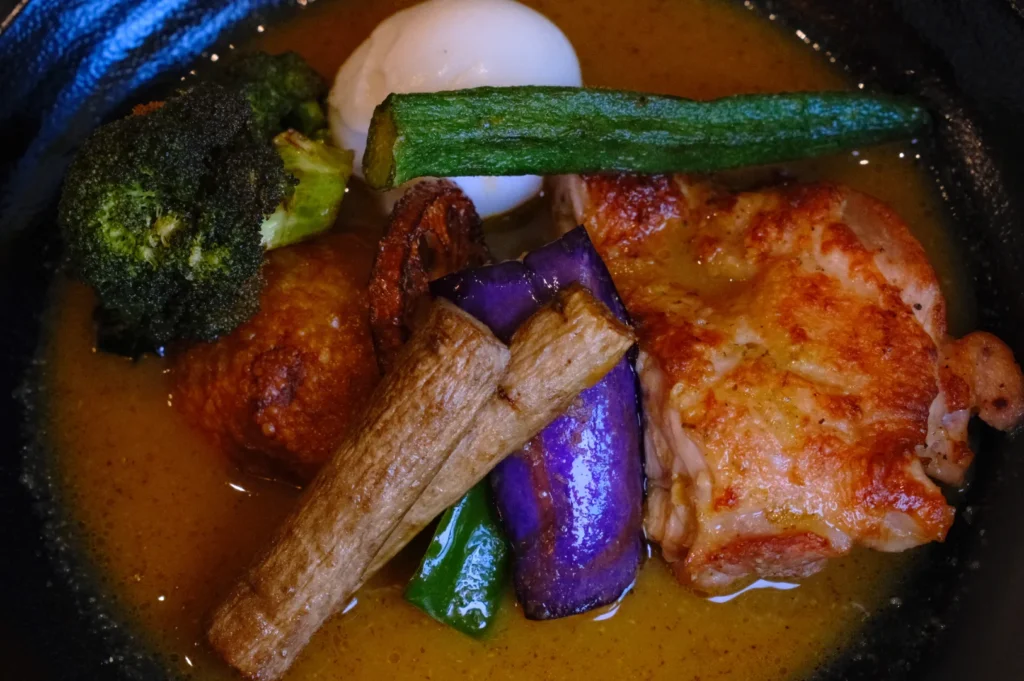
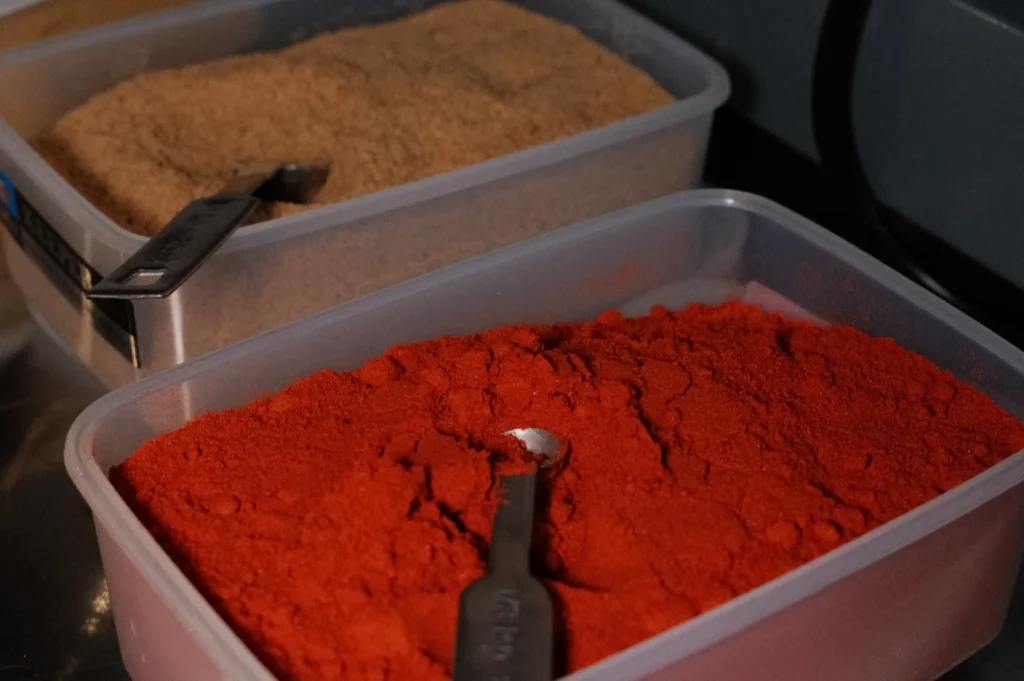
Soup curry doesn’t work that way. The spice blend at its core, built from curry powder, garam masala and a handful of aromatics, is designed for depth rather than aggression. Onions, garlic and ginger are slow caramelised in a heavy bottomed pot until they turn a deep amber, forming a base that carries warmth without scorching the palate.
Chilli heat, when it appears, is entirely optional. Most soup curry kitchens, ours included, let guests choose their own spice level, which means the dish welcomes everyone from a toddler sharing a parent’s bowl to a diner who genuinely wants their forehead to sweat.
Why the Confusion Happens
The word “curry” in English carries so much cultural weight that it’s easy to assume every curry dish follows the same playbook. But curry, as a category, simply means a spiced, sauced or souped dish built around a blend of ground spices. How those spices are used, and to what intensity, varies enormously by region.
| Curry Style | Typical Heat Level | Spice Character |
|---|---|---|
| South Asian curries | Often high, chilli forward | Complex, layered, chilli dominant |
| Japanese curry roux (katsu style) | Very mild | Sweet, thick, mellow |
| Hokkaido soup curry | Adjustable, usually gentle | Aromatic, savoury, spice depth without burn |
The takeaway is simple. Spice level is a dial, not a default setting. Soup curry is built to be adjusted, not endured.
Myth Two: It Must Be Indian
This is perhaps the most persistent misunderstanding, and an understandable one. Curry, as a word, entered global vocabulary through South Asian cuisine, so the association runs deep.
Soup curry, however, is a Japanese invention with a specific birthplace: Sapporo, the capital of Hokkaido, Japan’s northernmost island. It emerged in the early 1970s and grew into something closer to a regional soul food than a passing trend. Locals in Sapporo don’t think of it as an import or a fusion dish. It is simply what curry means to them.
A Northern Japanese Identity
Hokkaido’s food culture is shaped by its climate. Long, cold winters call for dishes that warm the body from the inside, and soup curry answers that call directly. It borrows the concept of curry spice from South Asia, layers it into a Japanese-style broth, and finishes it in a way that feels entirely native to Japan.
In areas like Chuo Ward near Susukino Station, soup curry restaurants are a fixture of daily life, the way ramen shops or izakayas are elsewhere in the country. It sits comfortably within Japanese dining culture, served with a side of steamed white rice rather than naan or roti, and eaten with a spoon rather than torn bread.
Bringing that experience to Singapore means representing it as it actually exists in Hokkaido, not as a hybrid interpretation. That’s part of why we describe what we serve as Singapore’s first and only authentic Hokkaido soup curry, rather than simply another curry restaurant on the map.
What Actually Signals “Japanese” in the Bowl
A few details give the dish away as distinctly Japanese rather than South Asian:
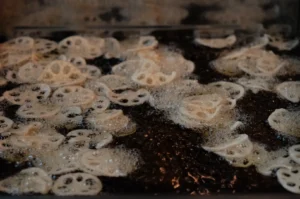
- The vegetables are deep fried separately using the su-age technique, a Japanese method of flash frying without batter, which keeps colours vibrant and textures light
- Chicken is placed on a wire rack lined with paper towels before serving, a small but deliberate step to keep the meat’s texture clean
- The rice is short grain, steamed Japanese style, and served on the side rather than folded into the dish
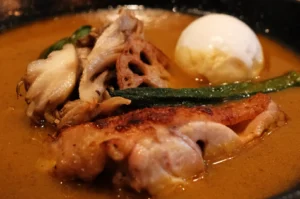
- The overall plating favours clarity and colour, with each vegetable, from lotus root to okra to pumpkin, kept visually distinct
None of this resembles a South Asian curry house. It resembles a Japanese kitchen that happens to use curry spice as its flavour backbone.
Myth Three: It Must Be a Thick Sauce
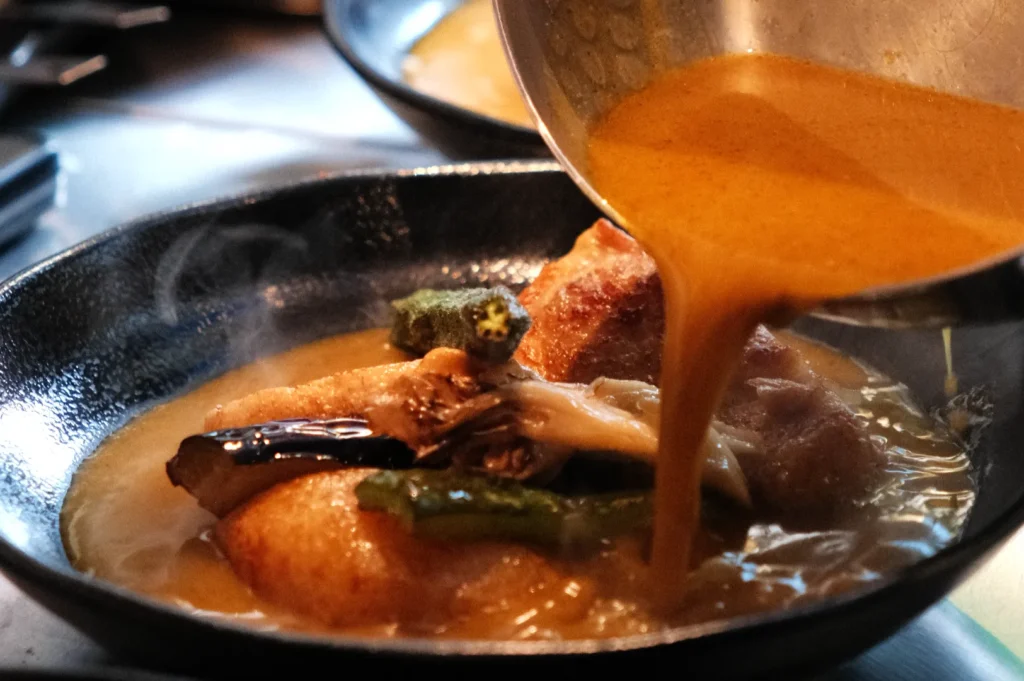
This is the misconception that catches people off guard the moment the bowl arrives. Many diners expect curry to cling to rice, thick enough to coat a spoon and hold its shape. Soup curry does the opposite.
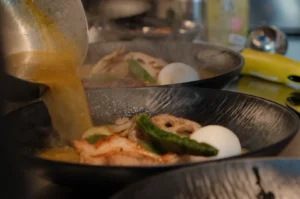
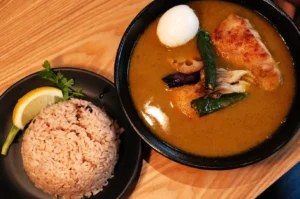
It is, quite literally, a soup. The base is built from chicken broth and chicken bones, simmered until the flavour runs deep, then seasoned with curry powder, garam masala and tomato paste. The result is a thin, pourable, deeply aromatic liquid, closer in texture to a broth you’d sip than a sauce you’d spread.
Soup First, Rice Second
Because the curry is served as a soup rather than a sauce, the eating experience changes completely. Rice comes on the side in its own bowl, and diners typically alternate between spoonfuls of broth and bites of rice, rather than having the two mixed together from the start.
This separation matters. It lets the broth stay light on the palate throughout the meal, rather than becoming heavier and starchier with every bite, which is often the case with thicker curry sauces. It also means the vegetables and chicken, which are cooked and prepared separately before being added to the bowl, keep their individual textures instead of softening into a stew.
Texture Comparison at a Glance
| Format | Consistency | How It’s Eaten |
|---|---|---|
| Traditional curry sauce | Thick, clings to rice | Rice and sauce mixed together |
| Soup curry | Thin, brothy, pourable | Rice kept separate, broth sipped or spooned |
For guests trying it the first time, the advice we tend to give is simple: don’t expect it to behave like the curry sauces you already know. Let the broth be a broth. Dip the rice into it, sip it between bites, and let the vegetables and chicken speak for themselves rather than expecting everything to merge into one uniform texture.
So What Is It, Then?
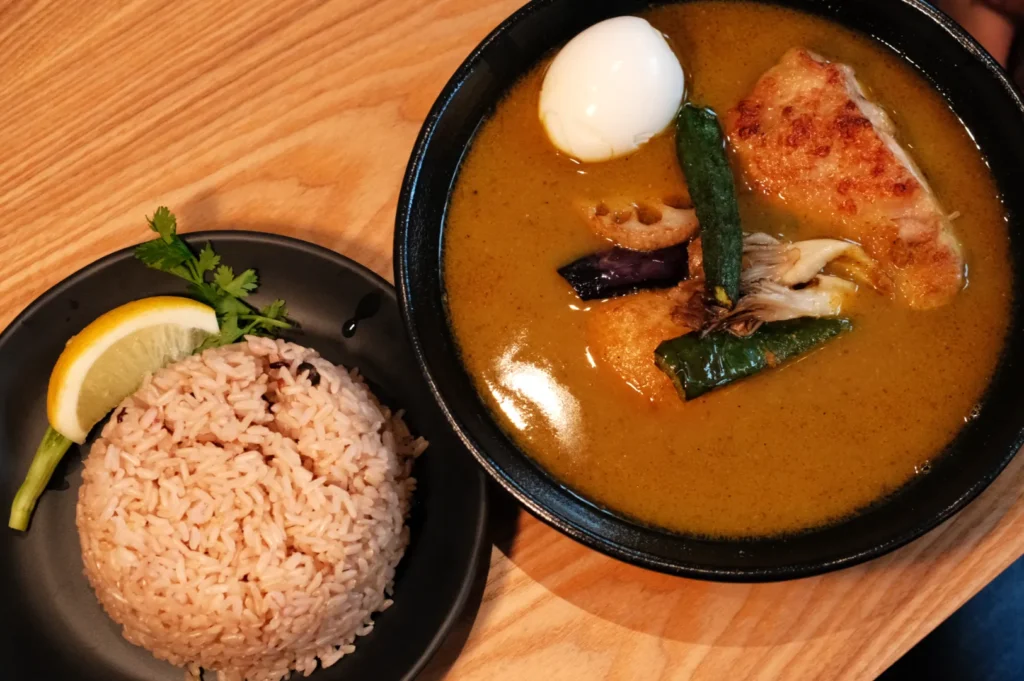
Strip away the assumptions, and soup curry reveals itself as something quite specific: a Hokkaido comfort food built on a light, aromatic chicken broth, seasoned with curry spice rather than doused in it, and served as a soup rather than a sauce. It isn’t a spicier or milder version of the curries already familiar in Singapore. It’s a different category altogether, with its own regional identity, its own texture, and its own way of being eaten.
That distinction is exactly why we’ve kept our approach close to what’s served in Sapporo itself, from the su-age vegetable technique to the slow caramelised broth base. Understanding the dish on its own terms, rather than filtering it through expectations set by other curry traditions, is really the whole point.
If the description alone has you curious, the easiest way to understand soup curry is still to sit down with a bowl of it. Our team at Soup Curry by Ki-Setsu serves it the way it’s meant to be experienced, with the broth thin, the spice adjustable, and the vegetables and chicken given room to shine on their own.
From 6pm onwards, the space also shifts into a relaxed izakaya setting, which happens to be a fitting way to end an evening built around discovering a dish that defies most of what you thought you knew about curry.