It is one of those questions that sounds simple until you are actually sitting at the table with a bowl of something fiery in front of you. Junmai or daiginjo: which one do you reach for? The two are often positioned at opposite ends of the sake spectrum, one robust and earthy, the other refined and floral, and that difference matters enormously when spice enters the picture.
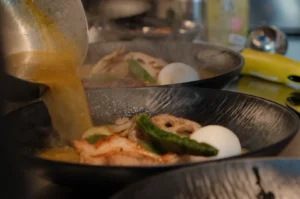
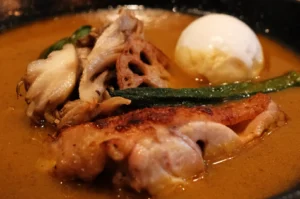
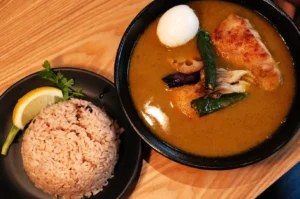
We think about this question a lot. At our restaurant, Hokkaido soup curry is the heart of everything we serve: a deeply aromatic broth built on chicken stock, curry powder, and garam masala, with spice levels guests can adjust to their own preference. Sake is a natural companion to this kind of cooking, and over time we have come to understand which styles genuinely hold their own against heat and which ones quietly suffer for it.
Here is our honest take on the junmai versus daiginjo debate, specifically in the context of spicy food.
What Makes Junmai and Daiginjo So Different
Before settling the argument, it helps to understand what separates these two styles at a fundamental level.
Junmai: Built for Flavour
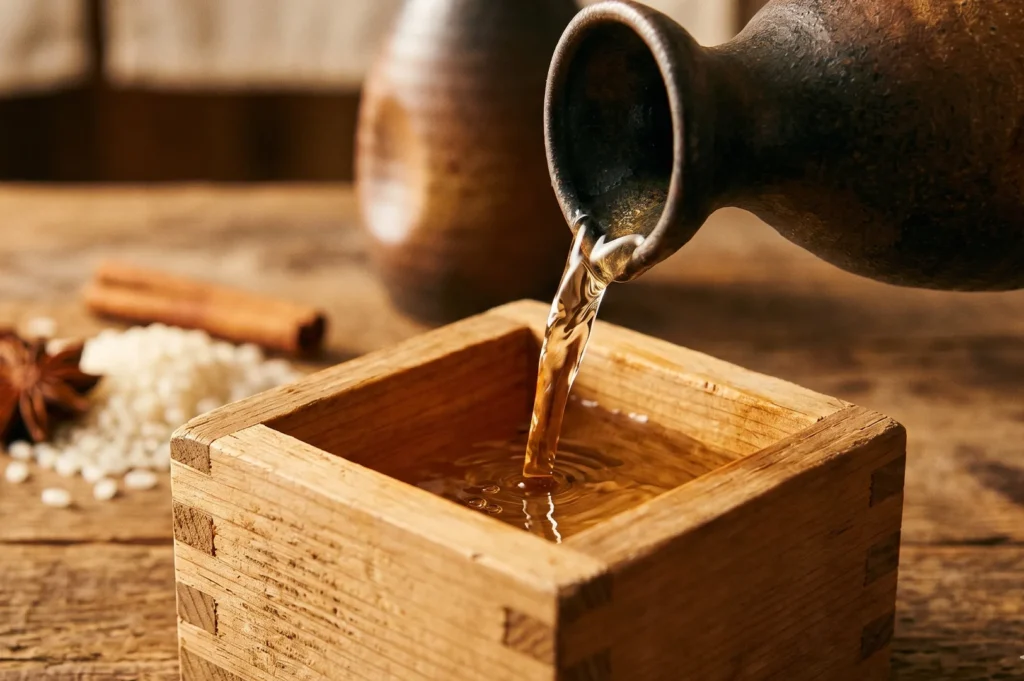
Junmai sake is brewed from rice, water, koji mould, and yeast, with no added distilled alcohol. The result is a sake with genuine body, a slightly higher acidity, and savoury, umami-rich notes that come through clearly on the palate. Because the outer layers of the rice are milled away less aggressively than in premium grades, more of the grain’s natural character remains in the final brew.
Junmai is not subtle. It has presence, texture, and weight. These are qualities that can be a disadvantage in delicate pairings, but they become genuine strengths when the food on the table has strong, assertive flavours of its own.
Daiginjo: Precision and Fragrance
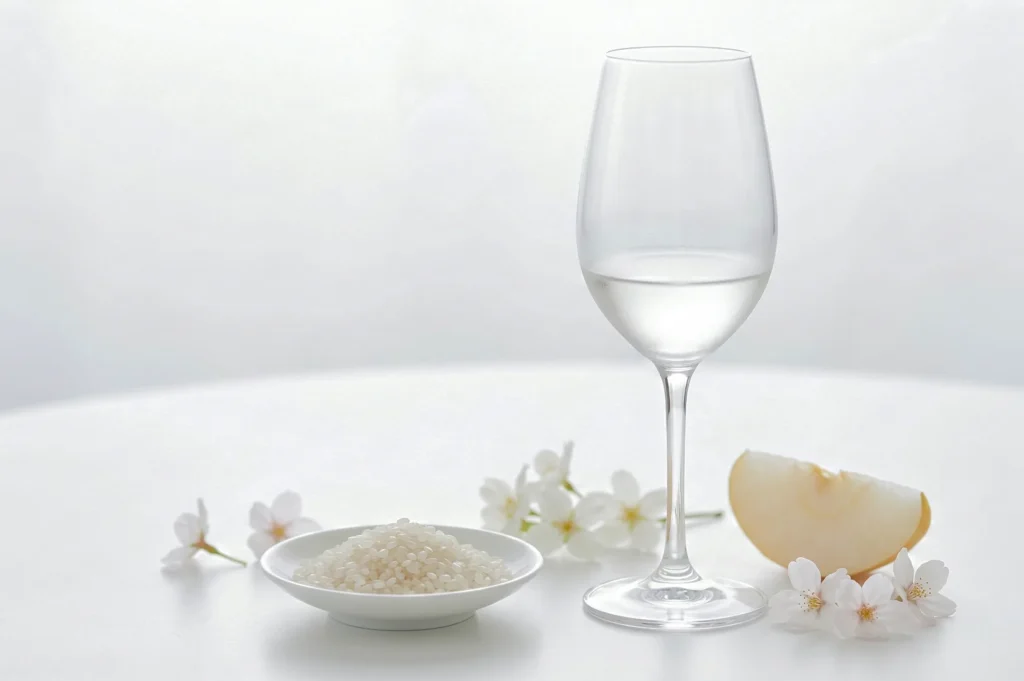
Daiginjo sits at the top of the sake quality pyramid. The rice is milled to at least 50 per cent of its original size, sometimes considerably more, stripping away the outer layers to leave a pure, concentrated core. The resulting sake is extraordinarily aromatic, often carrying notes of fresh fruit, white flowers, and clean grain. It is elegant, precise, and in many ways the showpiece of the brewer’s craft.
That elegance, however, comes with a caveat. Daiginjo is designed to be appreciated, not to compete. Its finest qualities are best experienced when nothing on the table is trying to shout over it.
How Spice Interacts with Sake
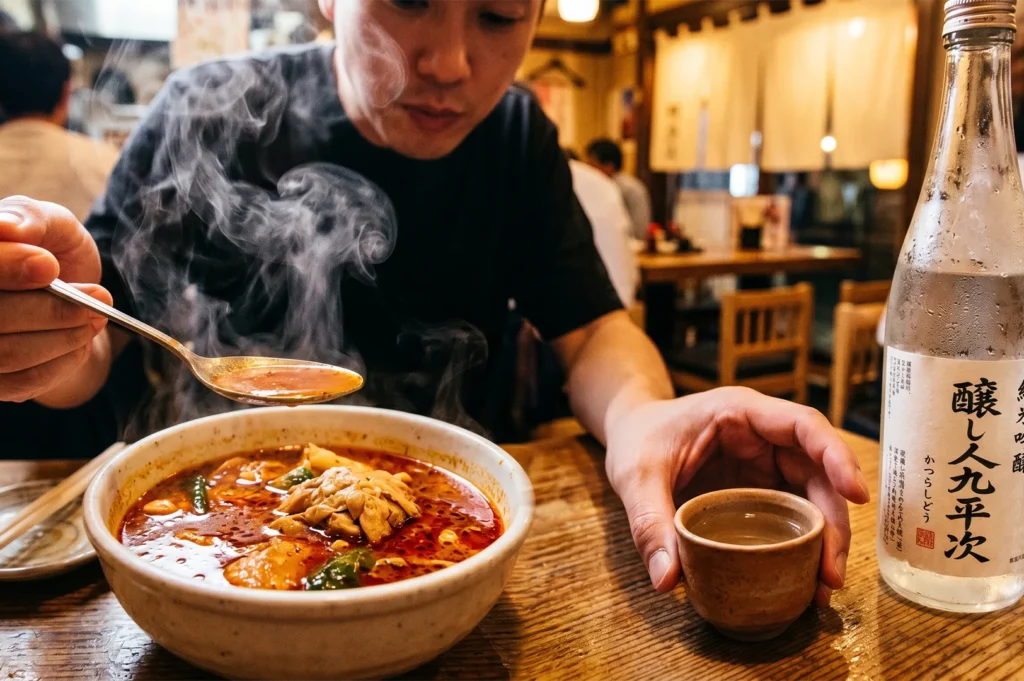
Spicy food does something particular to beverages. Alcohol amplifies capsaicin, the compound responsible for heat, rather than neutralising it. This is why reaching for a cold beer or a glass of wine after a chilli-heavy bite can sometimes intensify the burn rather than soothe it.
Sake, being lower in alcohol than most spirits and often lower in tannins than wine, tends to be gentler in this regard. But not all sake behaves the same way in the presence of heat.
Why Daiginjo Struggles with Spice
The problem with pairing daiginjo alongside genuinely spicy food is one of delicacy. The aromatic compounds that make a great daiginjo so beautiful, those soft fruity esters and floral notes, are extremely sensitive to environmental interference. Strong spice does not just compete with those aromas; it effectively erases them.
You take a sip of a beautifully crafted daiginjo after a mouthful of something heavily spiced, and the sake tastes flat. The nuances you paid for have vanished. Worse, any residual sweetness in the sake can interact with heat in an unpredictable way, sometimes making the overall experience feel cloying or unbalanced.
Daiginjo deserves food that steps back and listens. Spicy food does not do that.
Why Junmai Holds Its Ground
Junmai, by contrast, has the structural qualities that spice demands of a pairing. Its acidity acts as a palate cleanser, cutting through residual heat and refreshing the mouth between bites. Its body and weight mean it is not easily overwhelmed. The savoury, earthy character of a well-made junmai can actually find common ground with the complex spice profiles of dishes built on layered aromatics: cumin, coriander, garam masala, and the deep bass notes of a long-simmered broth.
This is exactly the dynamic we have observed alongside our soup curry. The aromatic depth of a Hokkaido-style broth, developed from chicken stock and a carefully balanced spice blend, meets junmai on level ground. Neither overpowers the other. The sake’s acidity brightens the soup, and the soup’s richness gives the sake something meaningful to work with.
A lightly warmed junmai alongside a spiced bowl of soup curry is, in our experience, a pairing that earns its place.
Does Temperature Change the Outcome?
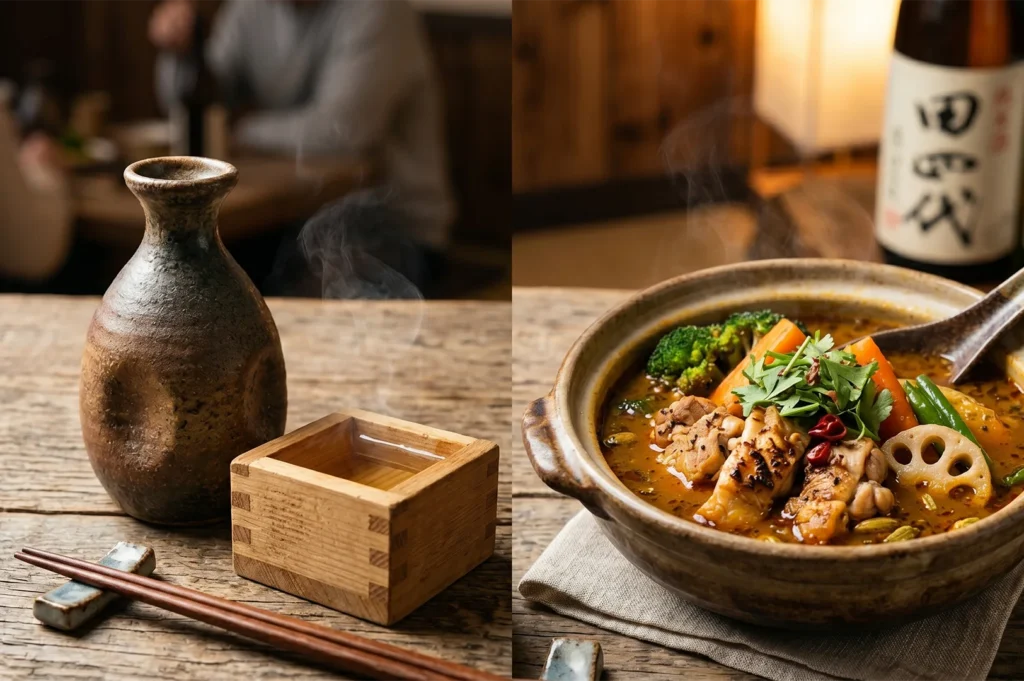
Temperature shifts the equation significantly, and this is worth understanding before drawing any firm conclusions.
Chilled Junmai with Spice
Served cold, junmai tightens up. Its acidity becomes crisper, and its body feels leaner. This works well with mildly spiced dishes, where you want a refreshing counterpoint rather than a warming companion. For moderate heat levels, chilled junmai is a clean and pleasant choice.
Warm Junmai with Spice
Gently warmed junmai, somewhere around 45 degrees Celsius, opens up in a way that suits richer, more intensely spiced food. The warmth softens the acidity slightly and amplifies the sake’s savoury depth, creating a pairing that feels cohesive rather than contrasting. On an evening when the soup curry is dialled up and the table is settling into a slow, comfortable meal, warm junmai is the right call.
Chilled Daiginjo as a Reset
This does not mean daiginjo has no place at a spicy meal. Used strategically, a small pour of chilled daiginjo between courses, or alongside a lighter dish at the beginning of the meal before the heat builds, can be genuinely pleasurable. Think of it less as a food pairing and more as a moment of quiet contrast: something refined and aromatic to mark a shift in the meal’s rhythm.
What We Have Learned from Serving Both
Running a restaurant where spice is central to the experience has given us a clear perspective on this debate. Guests who arrive unfamiliar with sake often gravitate toward daiginjo because its name carries prestige and its flavour profile sounds appealing in the abstract. And it is appealing, in the right context.
But guests who stay curious, who ask questions and try both options against the actual food in front of them, almost always land in the same place. Junmai, particularly when served at a temperature that suits the dish, is the sake that genuinely holds up.
That said, sake exploration is personal. Some guests prefer the contrast of a delicate daiginjo against something bold and savoury. Palates differ, and the best pairing is ultimately the one that feels right to the person drinking it.
The Verdict, Served Alongside the Bowl
If the question is strictly which sake holds up against spicy food, the answer is junmai. Its body, acidity, and savoury character give it the resilience to stay present and meaningful alongside heat-forward dishes. Daiginjo, as beautiful as it is, was not designed for this particular challenge.
At Soup Curry by Ki-Setsu, where the broth is aromatic and the spice is real, we see this play out every evening. The guests who pair a well-chosen junmai with their bowl often remark on how the whole experience feels more complete, as though the two were always meant to be on the same table together.
That, in the end, is what good pairing does. It makes you feel like nothing is missing.
We are open daily from 11:30 AM to 10:00 PM. Come in, choose your heat level, and let us help you find the sake that belongs beside it.