There is something quietly fascinating about the way two cultures can arrive at a similar idea and yet produce something almost entirely opposite in spirit. Singapore is a city where this happens constantly, and nowhere is it more visible than in the bowl. Laksa, that fiercely beloved local staple, and soup curry, the soul food of Japan’s northern island, are both spiced soups. Both are deeply comforting. Both command fierce loyalty from the people who grew up eating them. And yet, the moment you sit down with both in front of you, you begin to realise that the similarities end at the surface. What lies beneath is a study in contrasting culinary philosophies.
As the team behind Singapore’s first and only authentic Hokkaido soup curry restaurant, we’ve spent considerable time thinking about exactly this. Delving into Hokkaido soup curry history reveals a philosophy of culinary contrast. Here, we explore what truly separates these two beloved dishes, not to declare a winner, but to appreciate what makes each of them extraordinary on its own terms.
The Soul of the Broth: Richness vs. Clarity
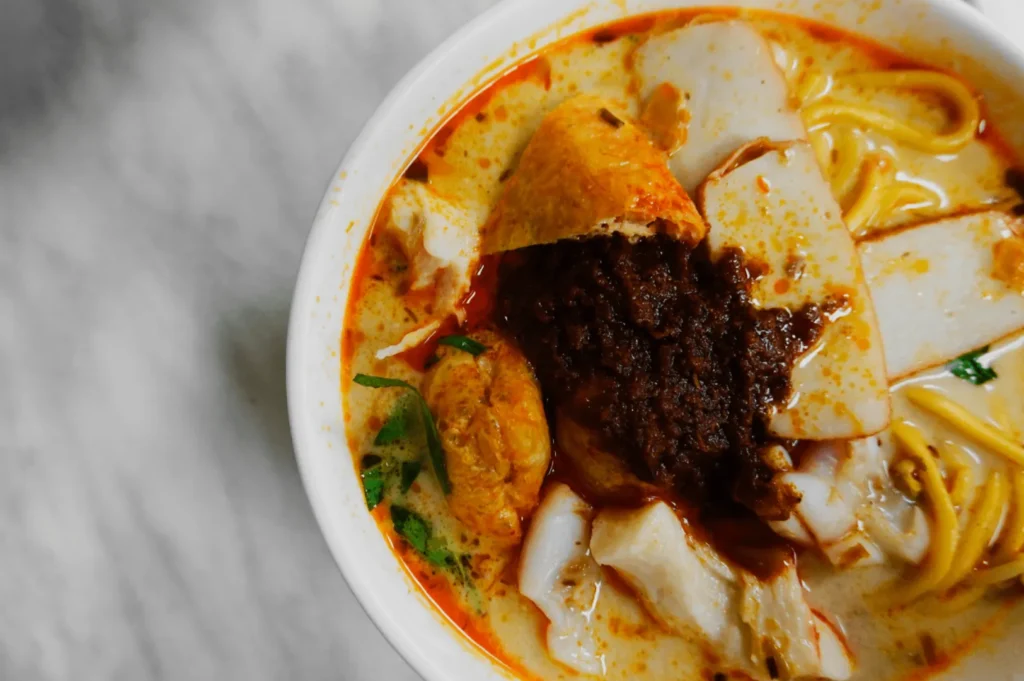
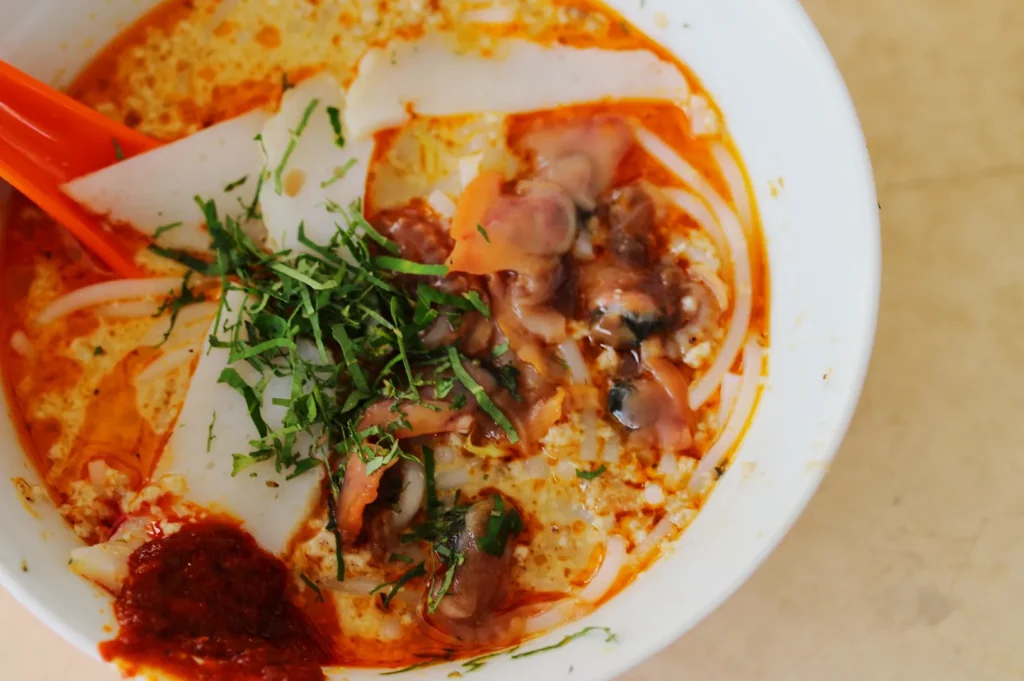
The most immediate and telling difference between laksa and soup curry is the broth itself. Laksa, particularly in its most popular Singaporean form, is built on coconut milk. The result is a broth that is thick, opulent, and intensely aromatic, with a heat that coats the palate rather than passing through it. Every spoonful carries weight. The richness is the point.
Soup curry moves in an entirely different direction. The base is light, almost delicate, built from chicken broth, ginger, garlic, and onions caramelised slowly to coax out deep, complex sweetness. Curry powder and garam masala are layered in with precision, and tomato paste provides a quiet acidity that keeps the whole thing alive. The result is a soup that is bold in flavour but clean in finish. It passes through rather than lingers, inviting you to keep going rather than overwhelming you after a few mouthfuls. In Hokkaido, where this dish was born in the early 1970s in Sapporo, the goal was always comfort without heaviness, warmth without excess.
This is not a small distinction. It reflects a fundamental difference in what each culinary tradition asks of a bowl of soup. Laksa says: be enveloped. Soup curry says: be sustained.
The Philosophy of Spice
Both dishes rely on spice, but the philosophy behind that spice could not be more different.
Spice as Identity vs. Spice as Architecture
Laksa’s spice profile is immediate and assertive. The rempah, that hand-pounded paste of lemongrass, galangal, chillies, shrimp paste, and candlenuts, forms the backbone of the dish. You cannot separate the spice from the soup. They are the same thing. The heat and fragrance are inseparable from the coconut base, and together they create something unified, almost indivisible.
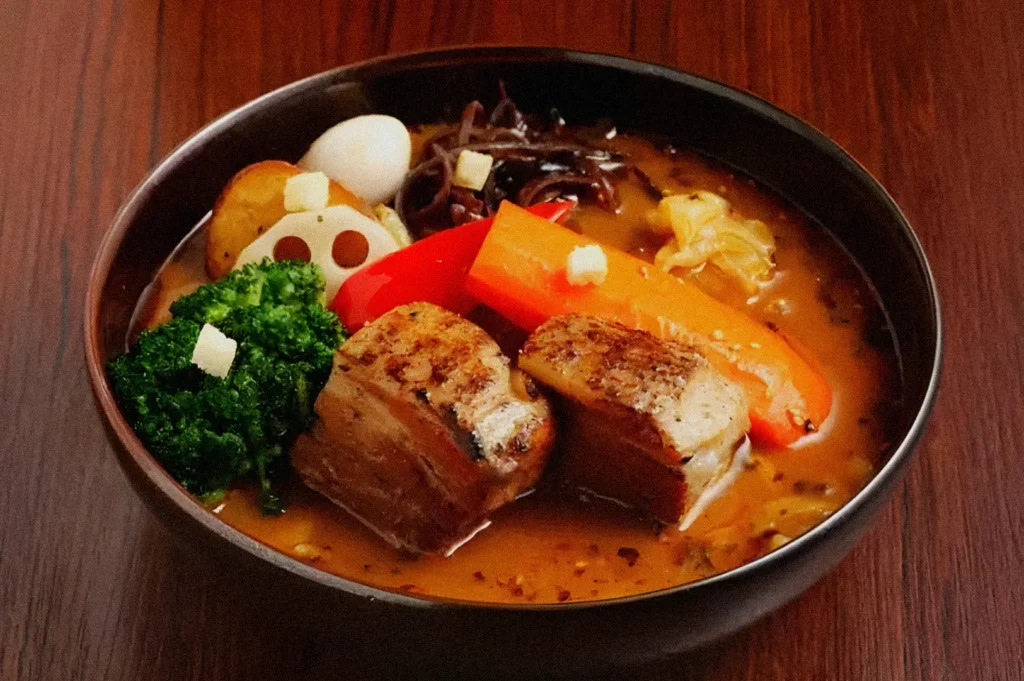
Soup curry approaches spice differently. Here, curry powder, garam masala, and a precise selection of aromatics are not there to dominate; they are there to build a structure within which everything else can exist. The broth carries the spice, but it does not become the spice. This allows the other elements of the dish, particularly the vegetables and the protein, to maintain their own character rather than being absorbed into the flavour of the base. It is a philosophy of co-existence rather than assimilation.
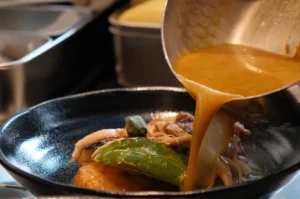
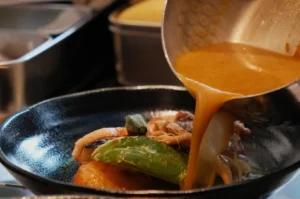
In our kitchen, we prepare the curry soup in a heavy-bottomed pot, taking the time to caramelise the aromatics properly before the spices are introduced. That patience is not incidental. It is the philosophy made practical.
Vegetables: An Afterthought vs. A Statement
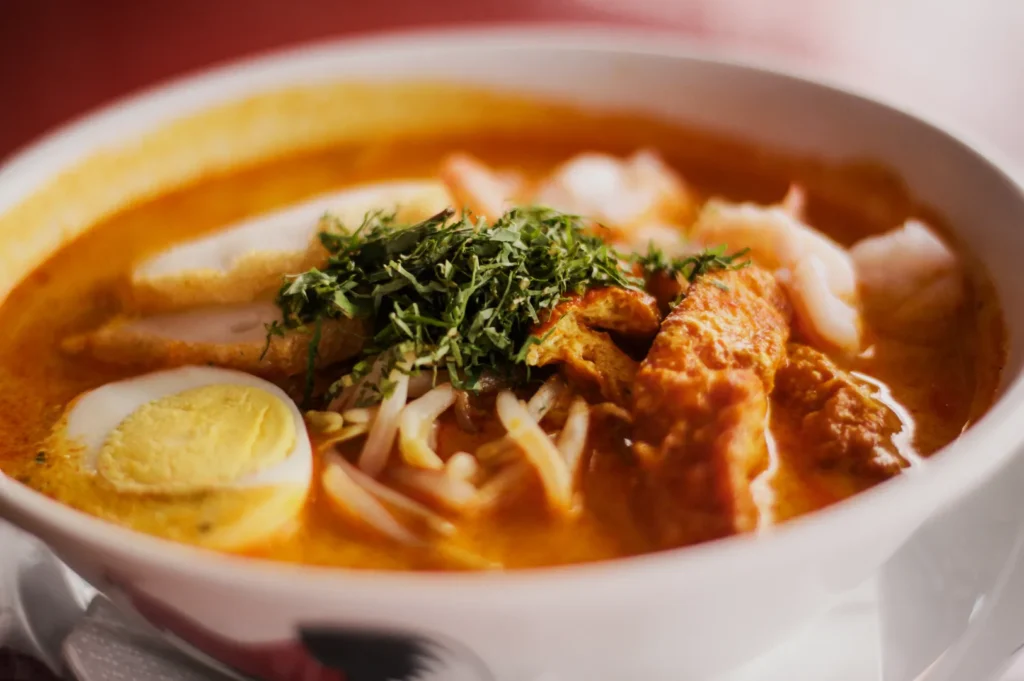
In most bowls of laksa, vegetables are present but they are rarely the focus. Beancurd puffs, fish cake, cockles, and a handful of beansprouts provide texture and contrast, but the star is the broth and the noodles.
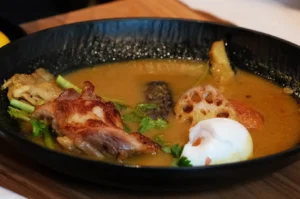
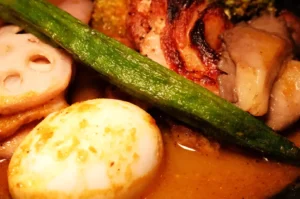
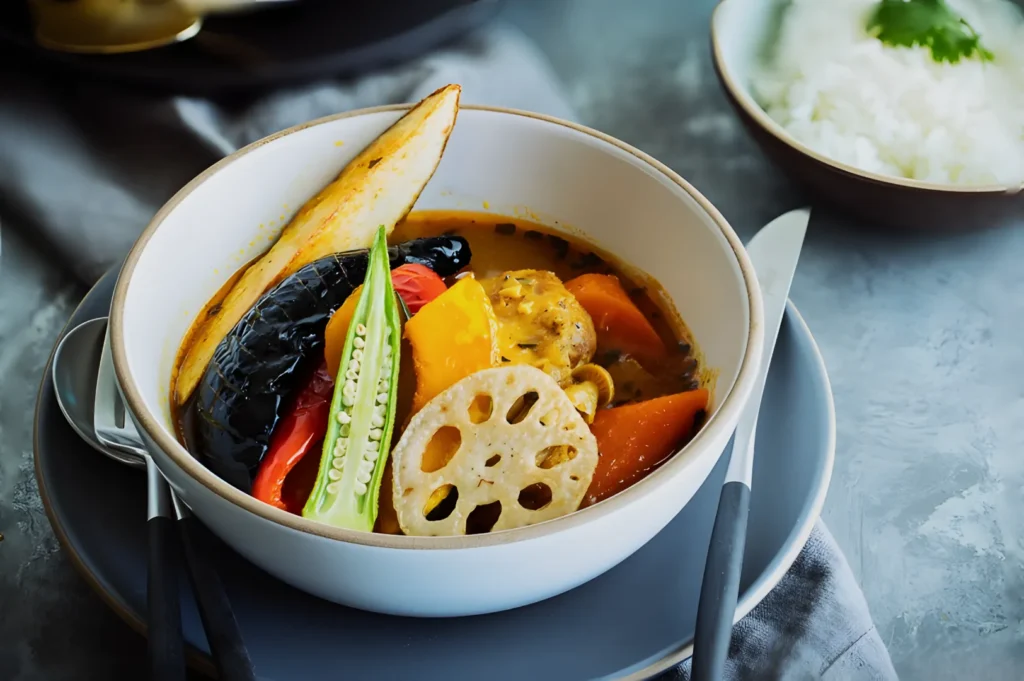
In soup curry, the vegetables are treated with as much intention as any other component. We use the Japanese su-age technique, flash-frying without batter, to preserve the natural colour, flavour, and texture of each vegetable individually. Bell peppers retain their sweetness. Lotus root holds its satisfying bite. Aubergine becomes silky at the edges without losing its structure. Pumpkin and potato, prepared using Japanese cutting methods, carry their own distinct character to the bowl.
Why the Cutting Method Matters
This is worth dwelling on, because it speaks directly to the philosophy. In Japanese culinary tradition, how you cut an ingredient affects not only its presentation but how it absorbs heat, how it releases moisture, and how it interacts with everything around it. The care taken at the cutting board is the same care taken at the pot. Every step is deliberate, and the vegetable is treated as something worth honouring rather than simply including.
Laksa operates differently. Its genius lies in the way it absorbs and transforms. The broth does the heavy lifting. Soup curry asks its components to remain themselves while contributing to something greater.
The Ritual of Eating: Together vs. Separately
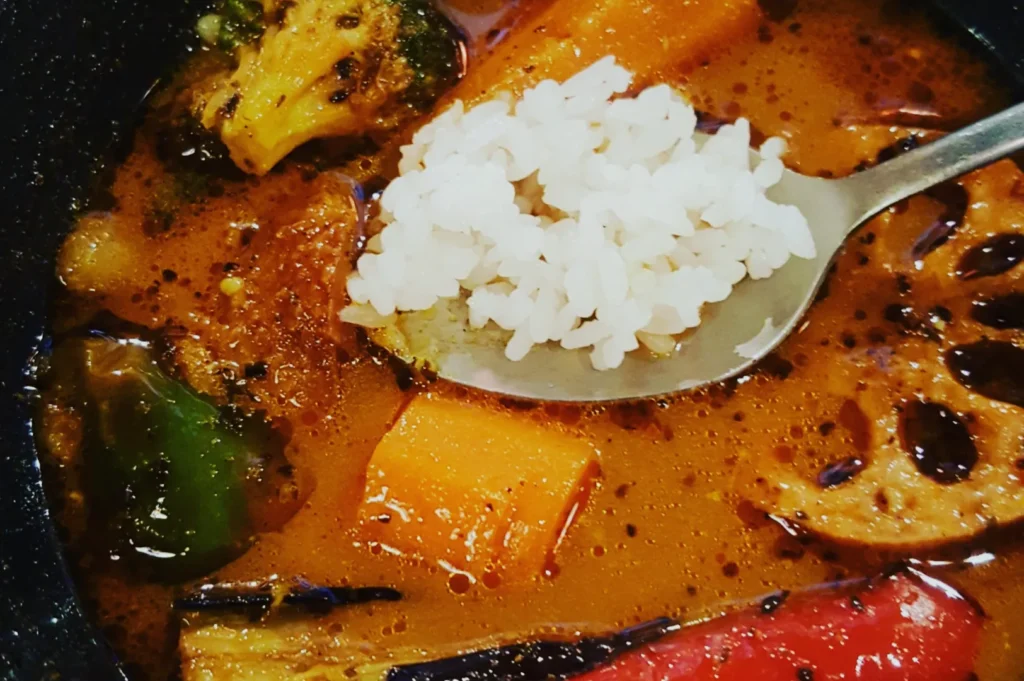
One of the most distinctive features of soup curry, and one that genuinely surprises first-time diners, is that the rice is served separately. In laksa, the noodles sit submerged in the broth from the moment the bowl arrives, soaking up colour and flavour as you eat. The two are inseparable.
In soup curry, the steamed white rice arrives beside the bowl, and you control how the two meet. You can dip a spoonful of rice into the soup, letting it absorb the broth gradually. You can eat them in alternation, or you can keep them largely distinct throughout the meal. This choice is not incidental. It reflects a Japanese approach to the dining experience that values individual texture and flavour integrity over convenience.
It also changes the pace of eating. Laksa demands immediacy, the noodles soften quickly and the broth is best at the moment it is served. Soup curry invites a slower, more considered approach. The broth stays consistent. The rice waits patiently. You set the rhythm. There is something meditative about it once you understand what is being asked of you.
Comfort Food, Different Climates
Perhaps the deepest philosophical divide between these two dishes lies in the climate they were born to serve.
Laksa evolved in a tropical setting, a hot and humid place where flavour had to be bold enough to be felt despite the heat. The coconut milk base, the assertive rempah, the generous portions: these are all responses to an environment where the contrast needed to be significant to register as comfort.
Soup curry was born in Hokkaido, Japan’s northernmost and coldest major island. Sapporo winters are long and biting. The comfort a bowl of soup curry provides is the warmth of something penetrating and sustaining, a dish designed to restore the body from the inside out without weighing it down. The lightness of the broth makes sense in that context. You need to feel warm, not full.
When we bring this dish to Singapore, an environment far removed from the Hokkaido cold, the warmth it offers becomes something more emotional than physical. Soup Curry by Ki-Setsu was founded on the belief that this kind of soul food translates across geography, that the gentle, considered comfort of Sapporo’s most beloved dish can find a home in a city that already knows, deeply, what it means to love a bowl of soup.
Two Bowls, Two Truths
Laksa is brilliant. It is bold, generous, and unapologetically itself. It reflects a culinary tradition built on intensity, layering, and the transformative power of a great paste and a great broth working in perfect union.
Soup curry is something different. It is careful, considered, and quietly profound. It asks you to notice things: the texture of a piece of lotus root, the way the broth shifts when you stir it, the moment when rice and soup come together at just the right ratio. It is a dish that rewards attention.
These are not competing philosophies so much as complementary ones. Singapore is a city large enough and curious enough to hold both. And we think that is exactly what makes it the right place to explore what a bowl of soup, approached with genuine intention, can become.