If you think you know Japanese curry, we understand. The thick, golden-brown sauce ladled over steamed rice, the tender chunks of potato and carrot, the sweetness from the curry roux that coats every grain. It is comforting, familiar, and deeply loved across Singapore. But there is another curry that most people here have never encountered, one that challenges everything you assume about what Japanese curry can be. Soup curry is not a variation on what you already know. It is an entirely different experience, and once you eat soup curry for the first time, you will wonder how you went without it.
We are here to tell you about that difference, because it is the reason we opened Singapore’s first and only authentic Hokkaido soup curry restaurant.
What Makes Soup Curry So Fundamentally Different from Traditional Japanese Curry
The gap between soup curry and traditional Japanese curry is not just textural. It is philosophical.
Regular Japanese curry is built around the curry roux, a block of fat, flour, and spice that thickens the sauce into something almost stew-like. The flavour is mild, sweet, and rounded, designed to be universally pleasing. It is, without question, delicious. But the roux is also what defines its limits: the sauce clings to the rice, the vegetables break down into it, and every element becomes part of one unified, heavy mass.
Soup curry asks a different question entirely. What if the curry were a broth?
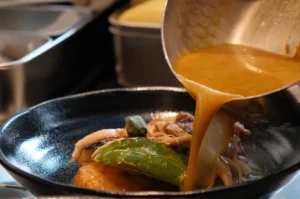
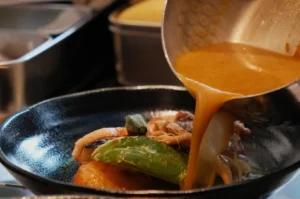
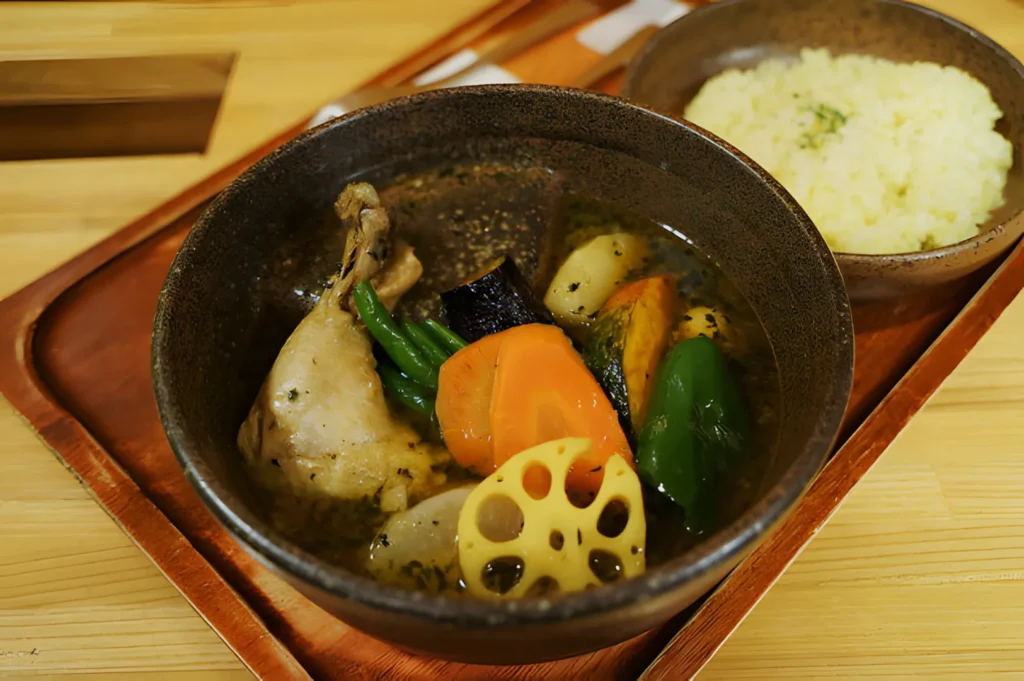
Instead of roux, the base is built from chicken bones and pork bones simmered low and slow into a deeply savoury foundation, then layered with aromatics such as garlic and ginger, warmed with curry powder, enriched with tomato paste, and brought together with garam masala, chili peppers, and other aromatic spices. The result is a light curry flavoured soup that is simultaneously complex and clear, bold and clean. There is no starchiness, no heaviness. Just flavour. All the ingredients work in concert rather than dissolving into one another, which is precisely what makes the original soup curry so unlike anything else in the Japanese food canon.
The Sapporo Soul Food You Have Never Tasted Until Now
To understand why soup curry hits differently, you have to understand where it comes from. Sapporo soup curry is the soul food of Hokkaido’s capital city, a dish born in the early 1970s in the chilly northern streets of Sapporo. In a city known for Hokkaido’s fresh produce and cold winters that demand warming, nourishing meals, soup curry became the answer. It is not a tourist creation or a restaurant gimmick. It is a proud local dish, passed down through decades of soup curry restaurants that have perfected their own recipes and spice blends, each house proud of its distinct broth.
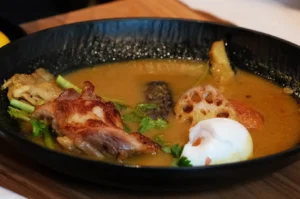
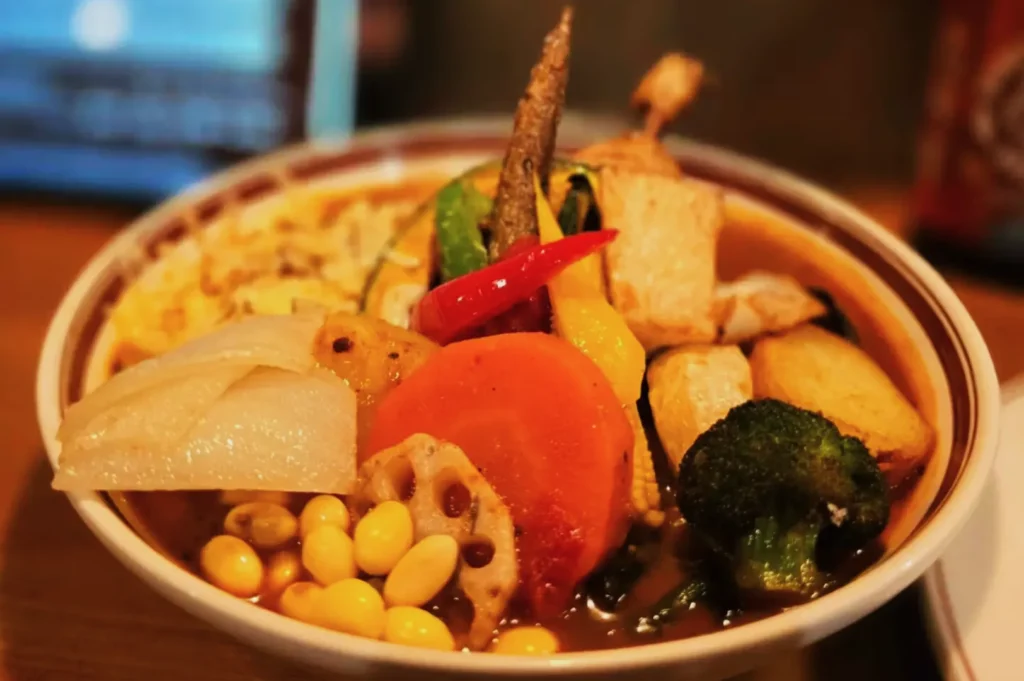
What sets authentic soup curry apart from any other curry soup you may have tried is the intentionality of its construction. This is not a thinned-down curry. It is a dish designed from the ground up to be a soup dish, with every element built to complement the broth rather than disappear into it. The rice sits separately on the side, so you control how much you scoop into each spoonful. The vegetables are not simmered until soft. They arrive vibrant and intact, because in authentic Hokkaido soup curry, the vegetables are treated as something to be celebrated, not merely cooked.
Fresh Vegetables and Fresh Ingredients, Preserved Through the Japanese Su-Age Technique
This is where authentic soup curry truly separates itself, and where our approach stays closest to tradition.
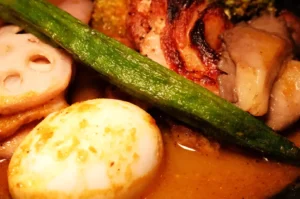
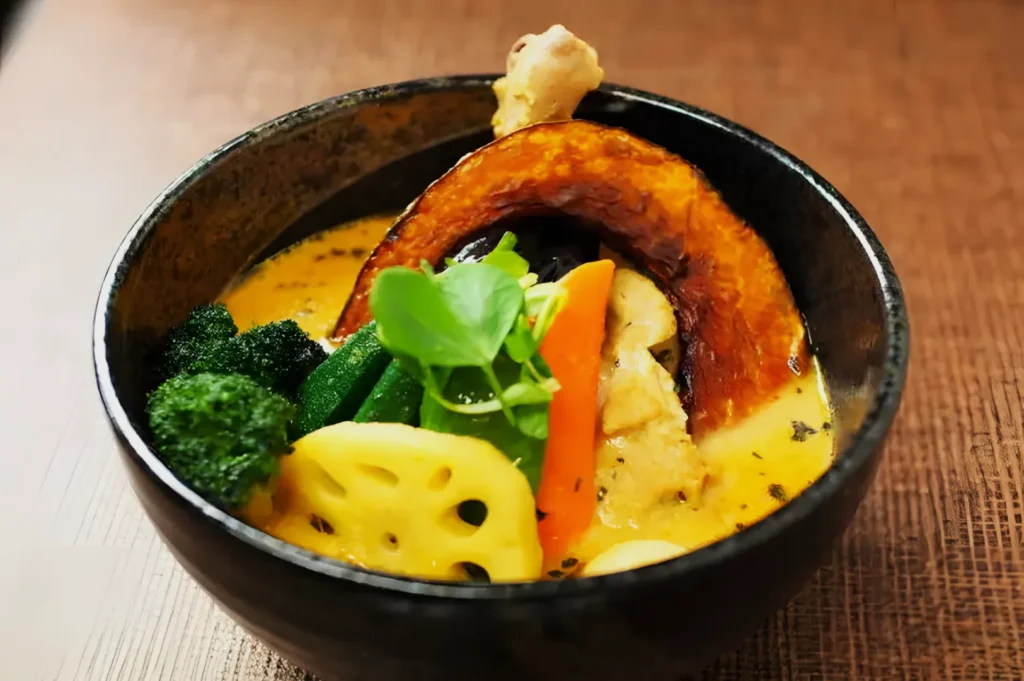
The fresh ingredients in every bowl begin with the vegetables, each one selected for quality and prepared using the Japanese su-age technique: a method of flash frying without batter. Bell peppers, lotus root, eggplant, potato, okra, carrot, and kabocha pumpkin are deep fried individually at the right temperature until golden brown on the outside while retaining their natural sweetness and vibrant colours inside. The technique draws moisture from the surface while sealing the interior, so each vegetable holds its shape, its flavour, and its texture when it arrives in the bowl.
Before serving, the prepared chicken and vegetables are rested on a wire rack lined with paper towels, a step that keeps excess oil from weighing down the final presentation and ensures every component arrives at the table at its best. It is a small detail, but in a dish where texture matters this much, it makes all the difference.
This matters because when you eat soup curry, you are not eating a uniform dish. You are eating a composition. Each piece of deep fried vegetable brings something different: the slight bitterness of eggplant, the crunch of lotus root, the sweetness of kabocha pumpkin, the mild heat of bell peppers. Submerge a piece into the broth, let it absorb the aromatic spices, and lift it to your mouth with a spoonful of soup. That is the moment soup curry reveals itself fully.
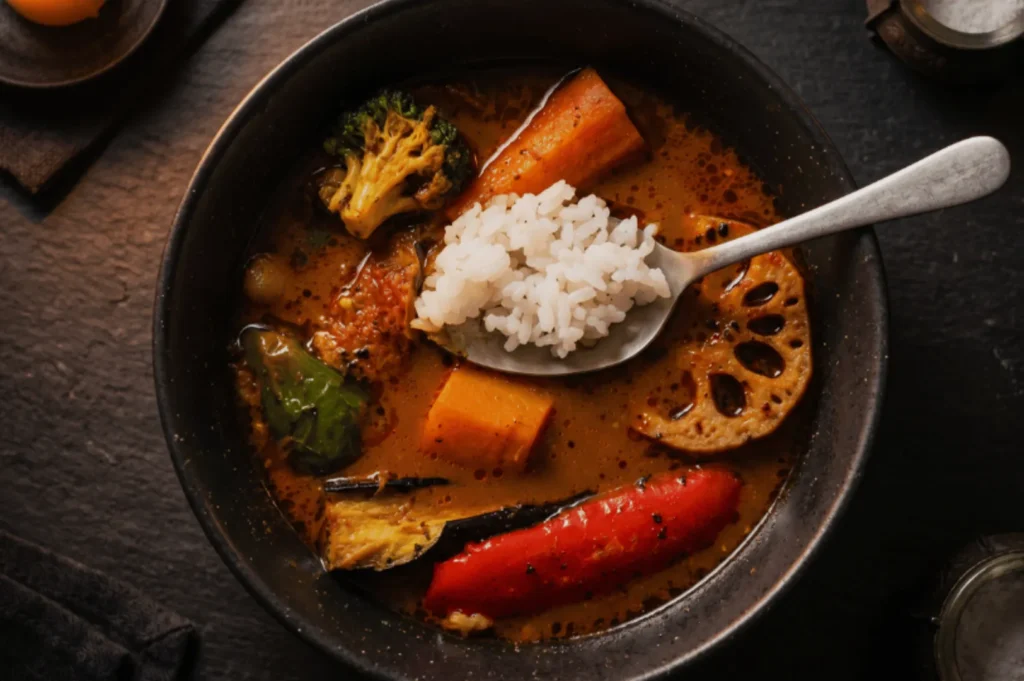
Part of what makes the experience of eating soup curry distinct is the ritual of it. There is no single correct way to eat it, and that freedom is intentional.
Some diners pour a little rice into the broth at the start, letting each grain absorb the soup. Others eat the assorted vegetables and chicken first, dipping into the broth between bites, and finish with the rice. Many alternate: a spoonful of broth, a bite of meat, a piece of fried vegetable, a scoop of rice. The bowl is interactive in a way that a plate of regular Japanese curry simply is not.
For those who want to explore variations, pork makes a wonderful addition, its flavour pairing naturally with the chili peppers and spiced broth. The dish is versatile in this way. Whether you prefer chicken, pork, or a combination of both, the signature dish remains defined by its broth, its fresh vegetables, and the care taken at every step of preparation.
The chicken itself is slow-cooked to tenderness, falling off the bone with minimal resistance. When you tear into it with your chopsticks and let the piece rest in the soup for a moment, the broth seeps in and amplifies the flavour from within. This is the kind of meal that rewards patience and attention. Rushing it misses the point.
Authentic Soup Curry Restaurants: Our Own Take on a Hokkaido Classic
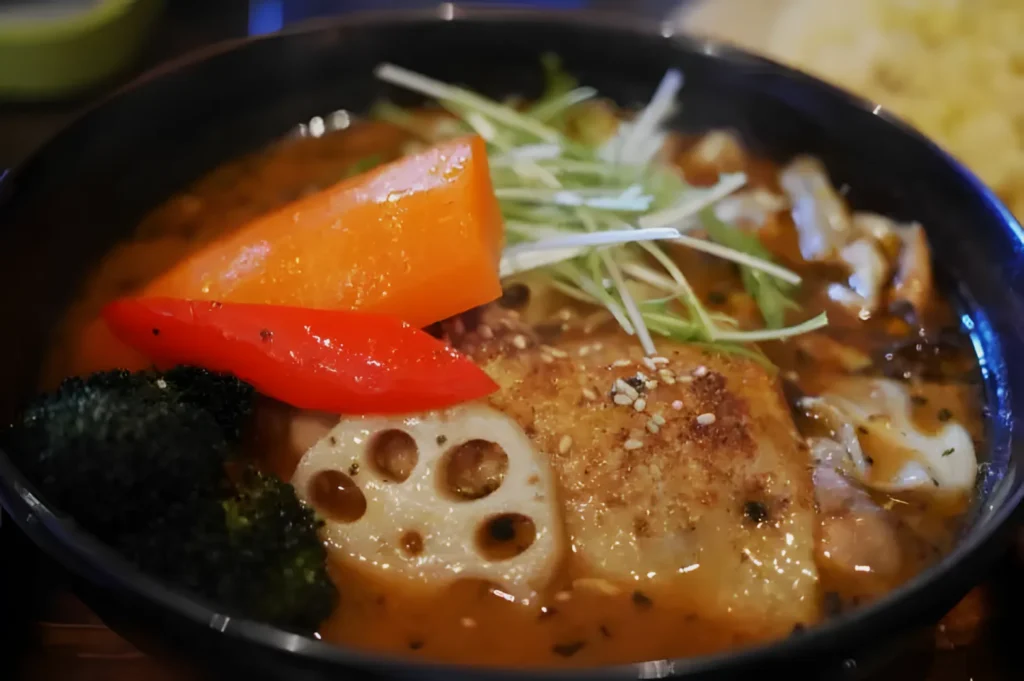
One of the defining features of soup curry restaurants in Sapporo is the belief that every bowl should reflect the character of the place it comes from. At the same time, every kitchen that takes soup curry seriously eventually develops its own take on the classic, a house interpretation built on the same foundational principles but expressing a distinct perspective through its choice of spices, vegetables, and broth construction.
Our own take begins with the broth. We build it in a heavy-bottomed pot, starting with caramelised onions, garlic, and ginger, then introducing chicken bones and pork bones for depth, followed by chili peppers for warmth and tomato paste for body. The spice blend is measured carefully, because in soup curry, the broth is everything. It carries the meal. When you comment something as delicious or deeply satisfying after the first spoonful, it is because the broth has done its job correctly.
We do not follow a review recipe pulled from a general source or adapt a dish based on required recipe ratings from online forums. Every decision in our kitchen traces back to what is authentic, what is fresh, and what honours the tradition this dish comes from.
Soul Food That Deserves a Seat at Singapore's Table
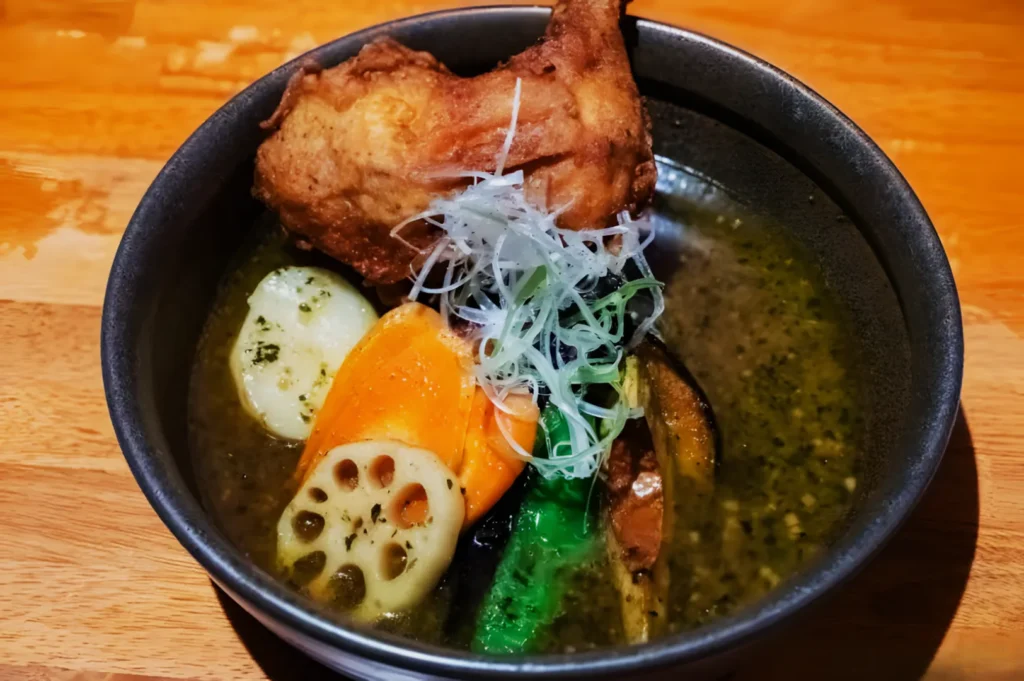
Japanese curry has had a long and celebrated presence in Singapore. We have no argument with that. But flavorful soup curry from Hokkaido offers something that traditional Japanese curry simply cannot: lightness, brightness, and the kind of depth that comes from a broth-based foundation built on fresh ingredients rather than a roux.
It is the difference between a dish designed to satisfy and a dish designed to nourish. Both are valid. But if you have spent years eating one and never tried the other, there is a whole register of flavour and texture waiting for you.
Sapporo’s iconic soul food is no longer something you have to travel to Japan to experience. Soup Curry by Ki-Setsu brings it here, prepared the way it should be, for those who are ready to find out what they have been missing.