At first glance, both might share a name, but soup curry vs Japanese curry is a comparison that reveals two genuinely different culinary worlds. One arrives thick and glossy, poured generously over a mound of steamed rice. The other comes to the table as a steaming bowl of fragrant, spiced broth, light yet deeply complex, with rice served on the side.
Here at Soup Curry by Ki-Setsu, we encounter this contrast every day: guests who arrive curious, having grown up with one style, and leave with a far deeper appreciation of both. We believe understanding this difference is the key to truly appreciating both dishes, and especially to understanding why soup curry occupies such a special place in Japanese cuisine.
The Core Difference in the Bowl: Soup Curry vs Japanese Curry
Japanese curry, in its most familiar form, is built around a curry roux: a blend of fat, flour, and a carefully balanced spice mix that is cooked down and combined with a rich, simmered stock.
Characterized by a thick, almost gravy-like sauce that clings to each grain of rice.
It is beloved for its dense texture, providing a hearty and comforting meal.
The flavor profile is slightly sweet, largely due to caramelized onions and carrots.
Convenience is a key factor in its popularity, with many households relying on house foods curry blocks.
Soup curry, on the other hand, begins from a completely different premise. Unlike traditional Japanese curry, it is not thickened with roux at all.
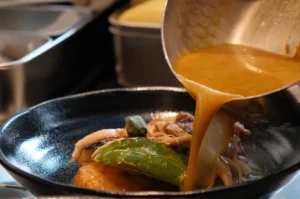
Characterized by a carefully constructed soup base made by simmering chicken and pork bones over many hours, extracting natural sweetness and mineral richness.
To the slow-cooked stock, layers of spices such as garam masala, curry powder, tomato, and various aromatic roots are added.
The final broth is thin enough to drink but layered with complex flavors that demand full attention with each spoonful.
This fundamental contrast in texture extends to how each dish is eaten. Typical Japanese curry is mixed directly with the rice, the thick sauce coating every bite. Soup curry is experienced differently: you eat it by dipping spoonfuls of rice into the broth, or sipping the soup between bites of vegetable and meat. It is interactive, tactile, and deeply satisfying in a way that feels new even to seasoned curry lovers.
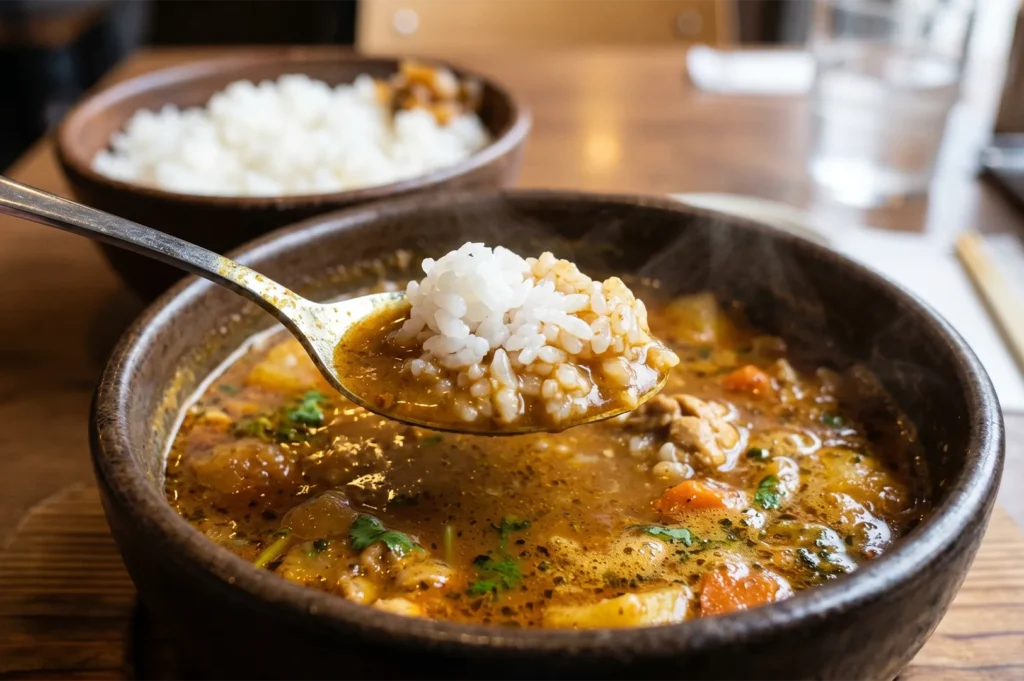
For those encountering this dish for the first time, knowing how to eat soup curry properly makes a real difference to the experience.
Soup curry is served with rice on a separate plate, not poured over the rice like traditional Japanese curry.
Take a small spoonful of rice and dip it gently into the fragrant soup before eating. This dipping method lets you control the balance of spice and starch in each bite.
Choose your preferred spiciness level before the meal, from mild to bold and fiery, to personalize your experience.
Enjoy the slow-building warmth of the spices, which complement the broth without overpowering it.
Feel free to ask the service staff for recommendations on spice levels or how to best enjoy your soup curry.
Savor the aromatic soup alongside each bite of rice and vegetables for a truly interactive and satisfying meal. It is no surprise that locals in Hokkaido describe their soup curry as soul food, something you reach for when the cold sets in and you need to feel genuinely nourished.
Sapporo Soup Curry: The Iconic Food of Japan's North
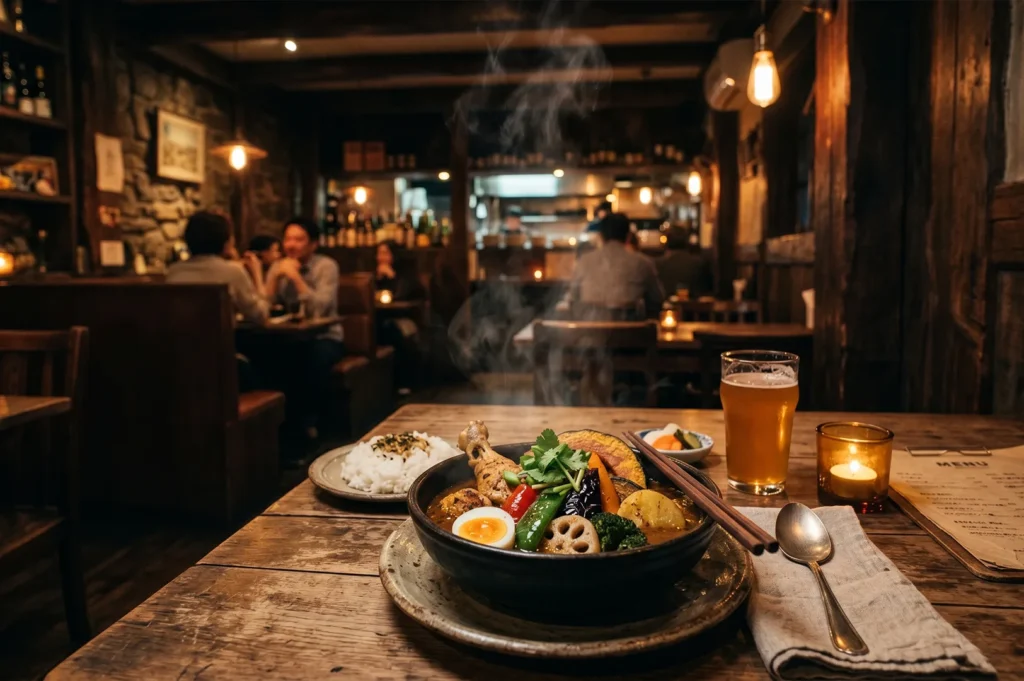
To understand why Sapporo soup curry developed the way it did, you need to think about Hokkaido’s environment and food culture. Japan’s northernmost major island is known for its biting winters, its agricultural abundance, and its food traditions that emphasise warmth and sustenance above all else.
The soup curry that emerged from Sapporo in the early 1970s was born out of this context. Restaurants in the Chuo Ward area began experimenting with spiced broths served alongside generous portions of meat and vegetables, creating something entirely distinct from the thick curry that was already a staple of Japanese home cooking.
Over the decades, Sapporo soup curry became an iconic food of the region, as beloved locally as ishikari nabe or fresh Hokkaido seafood. The dish carries with it a deep sense of place. Those who have visited Japan’s north and lined up outside a restaurant in the snow to eat soup curry will tell you the experience is irreplaceable. It is not simply a meal. It is a cultural expression of Hokkaido’s warmth and generosity, and the reason this dish has endured and spread far beyond the island where it was born.
What Makes Authentic Soup Curry Different: Fresh Vegetables and the Japanese Soup Base
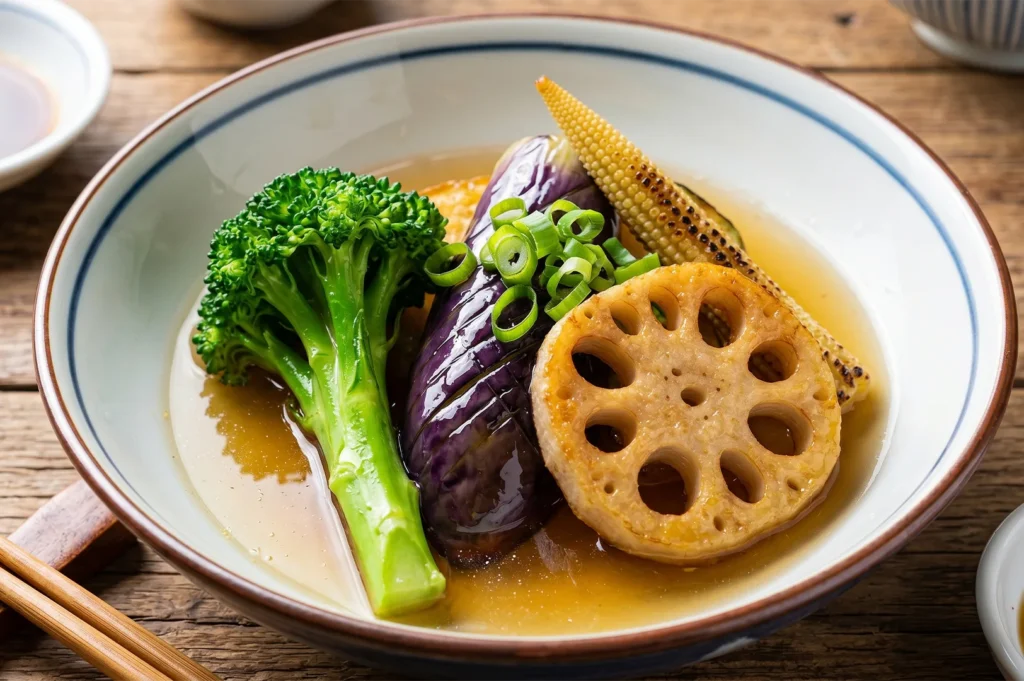
One of the most immediately striking things about authentic soup curry is the vegetables. This is not a dish where assorted vegetables are merely simmered until soft and stirred into a sauce. Instead, fresh vegetables are prepared individually and with care, each treated according to its own ideal cooking method.
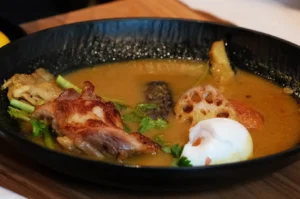
The Japanese su-age technique, a style of deep fried preparation using no batter, is applied to bell peppers, lotus root, okra, eggplant, potato, broccoli, baby corn, and carrot. This approach seals in colour, preserves texture, and concentrates the natural flavour of each ingredient.
The result is a bowl that is visually vibrant and texturally varied. Each vegetable retains its own character: broccoli stays a vivid green, and eggplant becomes silky while holding its shape. This is a level of vegetable curry craftsmanship that the thick sauce of typical Japanese curry simply cannot replicate, because the sauce overwhelms rather than complements.
The soup base itself varies between establishments. Our team uses a slow cooked Japanese soup base built from chicken bones and pork bones, simmered for hours before spices are introduced in carefully measured layers. Some variations draw on a coconut soup base for a softer, creamier broth, while others lean into tomato for acidity and depth. These differences in the soup base are as meaningful to soup curry as grape variety is to wine: they define the character of everything that follows.
Hokkaido Soup Curry and the Iconic Chicken Leg
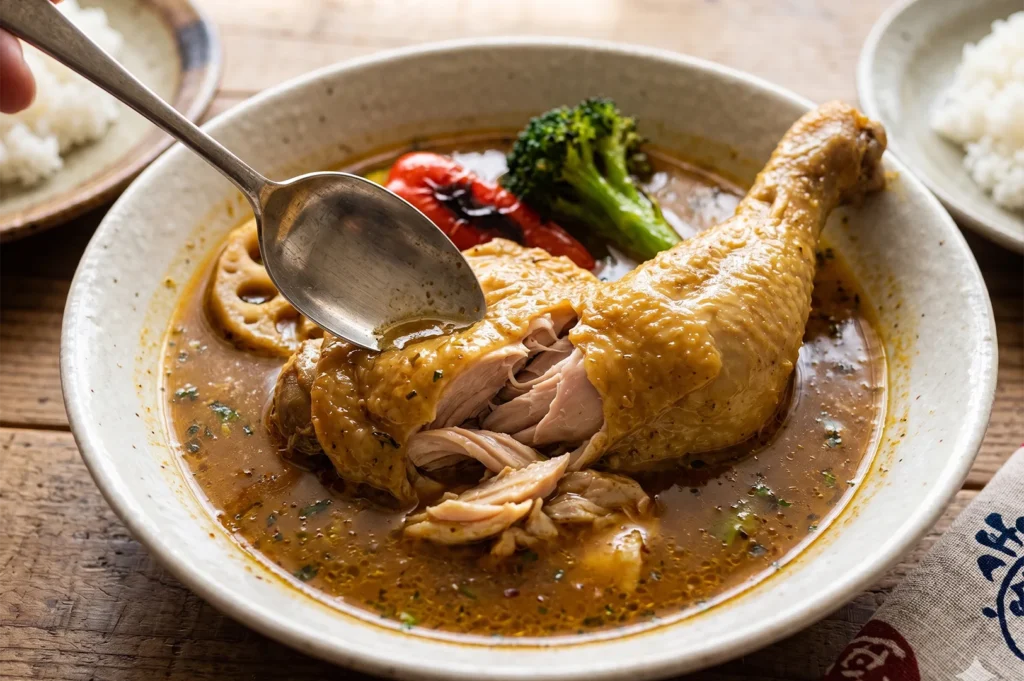
If there is one image that defines Hokkaido soup curry in the popular imagination, it is a single chicken leg, slow cooked until deeply tender, resting in a wide steaming bowl of fragrant, amber-coloured broth. This visual has become as iconic as the dish itself.
The preparation of this chicken leg reflects the philosophy of authentic soup curry. The chicken must be cooked long enough to be tender to the bone, yet the skin should still hold some texture. Achieving this requires care and precise timing. At our restaurant, each chicken leg is prepared so that it falls apart gently under the spoon, releasing its own juices into the surrounding broth and enriching the flavour of every sip.
By comparison, meat and vegetables in traditional Japanese curry are simmered directly in the sauce, absorbing its sweetness and becoming uniformly soft throughout. The textures blur together. In soup curry, every component retains its distinct identity. The chicken is chicken, the potato is potato, and the broth is its own remarkable thing entirely. This distinction in how pork, chicken, and other vegetables are treated speaks to a broader philosophy that sets soup curry apart as a dish of intention and craft.
House Foods, Curry Powder, and the Spice Philosophy Behind Each Bowl
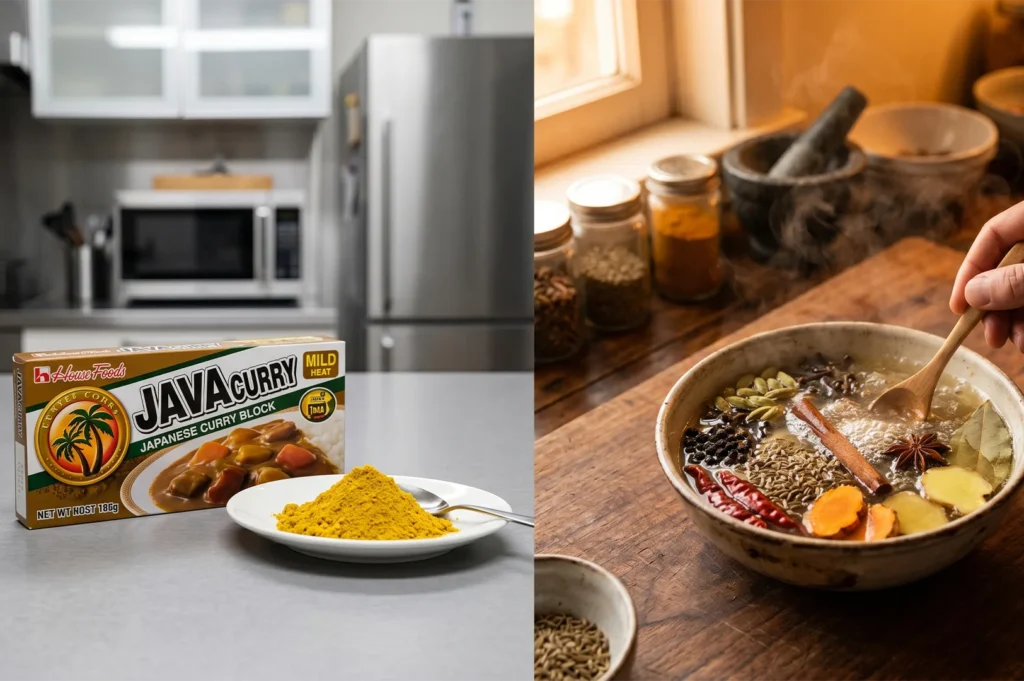
The household familiarity of Japanese curry owes much to the convenience of packaged roux products. House foods curry blocks helped establish the thick, sweet style of Japanese curry as a national staple, making it the ultimate comfort food of the home kitchen, eaten multiple times a week by families across Japan. These products contain a pre-blended curry powder alongside flour and fat, creating consistent results with minimal effort.
What sets Hokkaido soup curry apart in this regard is the deliberate, almost meditative approach to spice building. Our recipe for the broth has been refined to capture the precise balance of warmth, depth, and fragrance that defines the Sapporo style. The spice is present but never aggressive, encouraging you to keep eating rather than reaching for water. It is the kind of broth that rewards slow sipping, and the kind of dish that makes you plan your next visit before you have even finished your first bowl.
Two Curries, Two Different Souls
Both Japanese curry and soup curry are beloved for good reason. One is a rich, reliable comfort food, thick and sweet, deeply embedded in Japan’s domestic food culture. The other is a delicious spicy soup of remarkable complexity, born in the cold north and inseparable from the landscape and spirit of Hokkaido. Neither is better than the other: they simply offer different things.
What we hope, at our restaurant, is that guests who arrive expecting familiar Japanese curry leave with a far broader appreciation of what curry in Japan can be. The soup dish that fills our bowls is not a variation on something you already know. It is its own tradition, with its own logic, its own techniques, and its own deeply satisfying way of nourishing the people who eat it. Whether you are a long-time spice lover or someone tasting this style for the very first time, the experience of a proper Hokkaido soup curry bowl is one that stays with you.