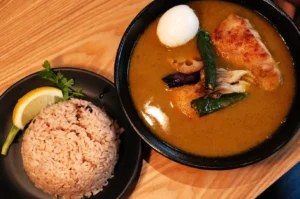
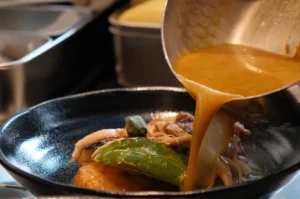
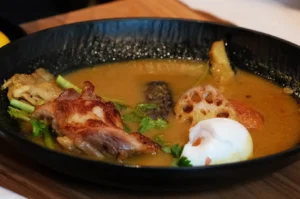
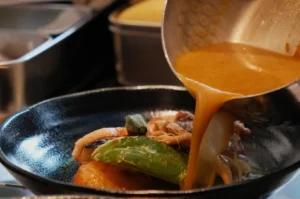
When people think of the best curry, they often imagine thick, gravy-laden dishes from South Asia or hearty home-style stews. But in Hokkaido, northern Japan, the finest curry is a refined, aromatic broth rather than a heavy sauce. To appreciate this dish, one must move beyond expectations of thickness and embrace the soul of the soup.
At our restaurant, many diners expect a thick curry sauce but are surprised by the light, flavorful broth. The spice dances gently through a clear, intricate liquid: a harmonious blend of herbs, vegetables, and slow-cooked protein. This soup curry is crafted to be a complete, satisfying meal, offering a fresh perspective on what curry can be.
Comparing Curry Chicken and Fish Head Curry: Flavours and Traditions
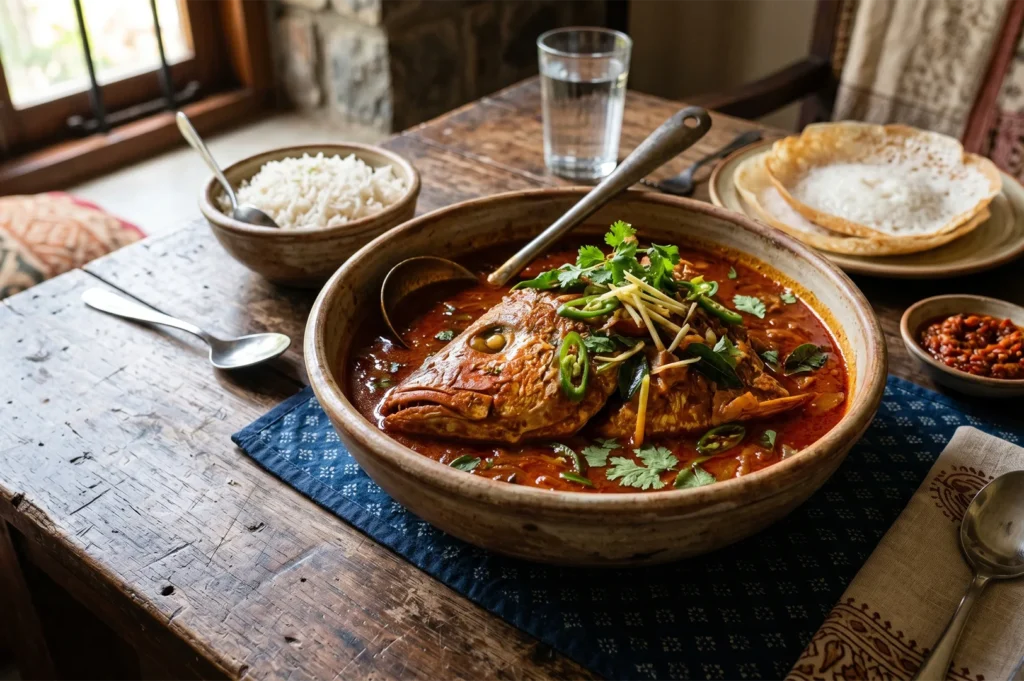
Singapore’s vibrant hawker scene is home to countless curry stalls, each offering their own unique take on the beloved dish. These stalls often blend aromatic spices with local ingredients, resulting in curries that vary from mild and creamy to fiery and robust. Fortunately, this diversity means there is a perfect curry for every palate, whether you prefer a rich coconut milk base or a spicier, tangier sauce.
The best curry experiences often come from places where the preparation is a labor of love, with fresh spices toasted and ground on-site to maximise aroma and flavour. Many stalls are located in bustling food centres, making them accessible spots to indulge in authentic, hearty curry rice dishes. The combination of fragrant spices, tender meats, and well-balanced sauces truly elevates each bite, making curry rice a perennial favourite among locals and visitors alike.
Challenging the Definition of Singaporean Chicken Curry
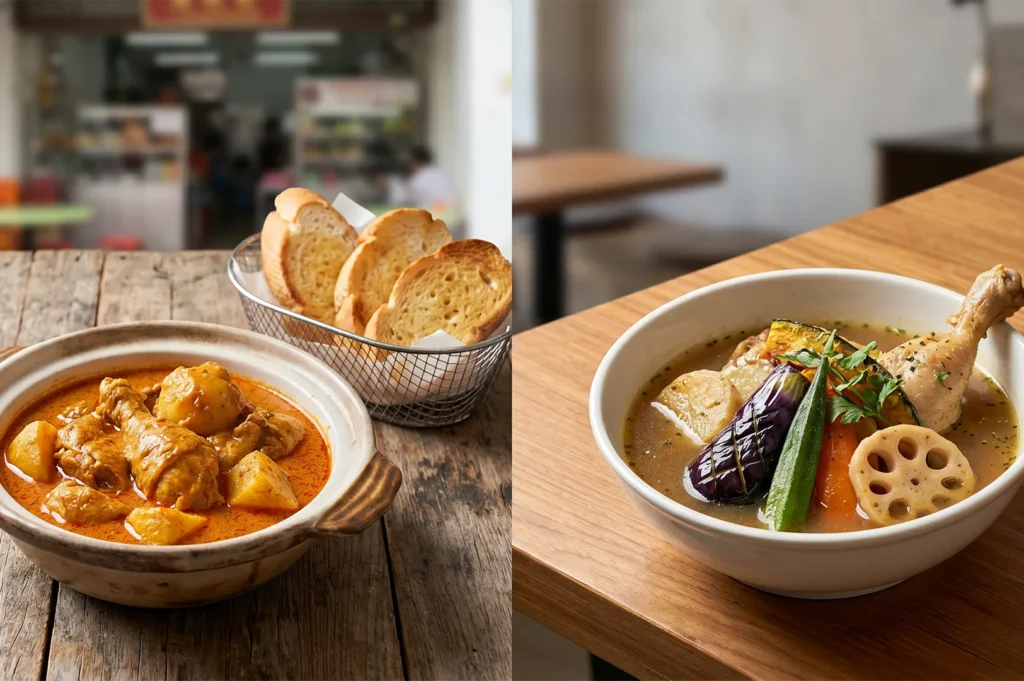
Every conversation about our soup eventually circles back to the same question: how does it compare to what people already know and love? It is a fair question, and to answer it honestly, we have to look at where the local tradition begins before we can explain where we diverge from it.
The Classic Comfort of Coconut, Spice, and French Loaf
In Singapore, we are spoiled for choice when it comes to spice. The local palate is accustomed to the bold, rich profile of a Singaporean chicken curry, often celebrated for its creamy coconut base and heavy infusion of aromatics.
This classic dish is a staple in many households, often paired with a toasted French loaf to mop up every drop of that velvety sauce. It is a masterpiece of comfort, deeply rooted in the history of our multicultural island, where the intersection of Chinese, Malay, and Indian influences has created a tapestry of flavours.
A Japanese Answer to Richness
The Japanese interpretation, however, offers a stark, refreshing contrast. While a standard curry chicken in many establishments relies on coconut milk or heavy cream to provide body and sweetness, our approach at Soup Curry by Ki-Setsu focuses on the clarity of the broth. We extract the essence of toasted spices and fresh vegetables, ensuring that each bite provides a clean, vibrant experience rather than a heavy one.
When we compare our soup to a traditional curry chicken, we are essentially looking at two different schools of thought. One seeks to coat the tongue in richness, while the other seeks to awaken the senses through complexity. For those who prefer a dish that is warming without leaving them feeling sluggish, the transition from a thick stew to a fragrant, spiced soup is natural. It is about understanding that the taste is not defined by the weight of the liquid, but by the intensity of the aromatics infused within it.
The Art of the Broth: Why Texture Matters
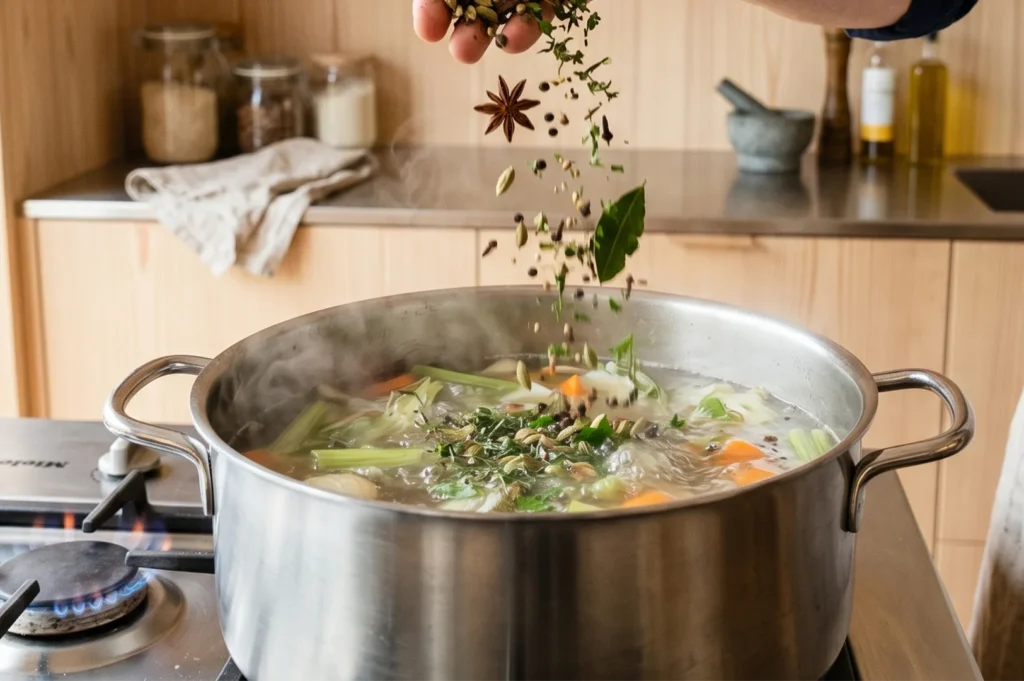
Much of what defines our soup is invisible to the eye. It lives in the decisions made hours before service, in the way we handle each ingredient and in the discipline of knowing what to leave out. Two principles guide everything we do in the kitchen, and together they account for the character of every bowl we serve.
Starting with a Clean Canvas
The secret behind the best curry is found in the preparation. Many believe that to achieve a delicious result, one must simmer ingredients for decades or use endless amounts of oil to create a thick consistency. In our kitchen, we take the opposite approach. We view the soup as a canvas where the flavour must be sharp, distinct, and layered.
We begin with a foundation of high-quality meat and a carefully curated selection of herbs and spices. Unlike recipes that bury the ingredients under layers of starch, we treat each component with respect. Our deep-fried vegetables, such as lotus root, bell pepper, and aubergine, are prepared using precise Japanese cutting methods. This ensures they maintain their structural integrity and natural sweetness while absorbing the broth.
When a diner dips a piece of bread into the bowl or enjoys a spoonful of rice alongside, they are experiencing the ingredients exactly as they were meant to be enjoyed: intact, tasty, and brimming with vitality.
Heat as Warmth, Not Weapon
The heat in our soup is not meant to burn the tongue, but to provide a gentle, lingering warmth that complements the fragrant notes of the spices. By omitting thickeners, we allow the natural properties of the chilli, the aromatics, and the seasonal produce to shine. It is a clean, sophisticated way of cooking that prioritises the health and well-being of our guests, ensuring that every plate is as nutritious as it is flavourful.
Bridging Cultures through a Shared Bowl
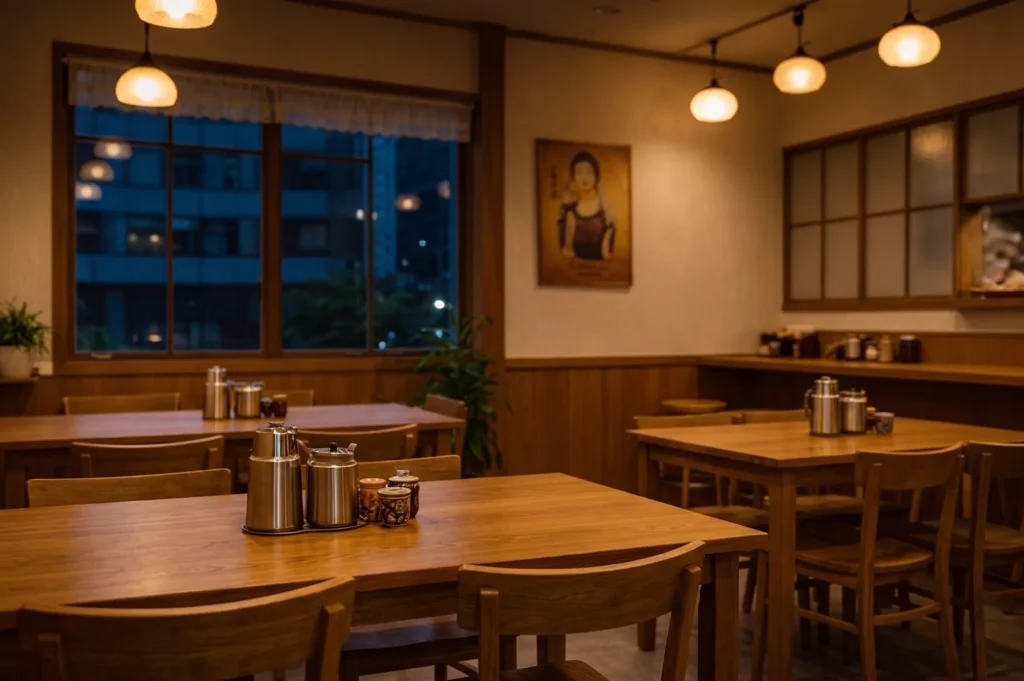
One of the most beautiful things about working in this industry is how people from all walks of life, whether they are local Singaporeans or visitors from afar, find common ground over a bowl of soup. We have asked many of our guests what drew them to our place for the first time. The answer is almost always a desire for something different, a recommendation from a friend, or a simple love for exploring new dishes.
We see families gathering, office workers seeking a satisfying lunch, and couples enjoying the transition from a lively dining room to a cosy izakaya atmosphere as the sun sets. The combination of the vibrant broth and the care taken in creating each bowl makes this dining experience truly memorable. It is a spot where the list of ingredients is short but intentional, and the results are consistently exceptional. And the more we speak with our guests, the more we realise that this feeling of connection is not accidental. It is rooted in something much older.
A History Rooted in Spice
We often observe guests looking at our menu, perhaps searching for a fish head curry or other familiar local favourites, only to be surprised by the uniqueness of our offering. We encourage this curiosity. There is a deep, historical link between the spice trade of India and the evolution of Japanese curry. What we serve is a modern evolution of that history, brought to life through the lens of Hokkaido’s agricultural bounty. It is not about replacing traditional recipes; it is about expanding the horizon of what a curry can be.
Why We Believe in the Soup Philosophy
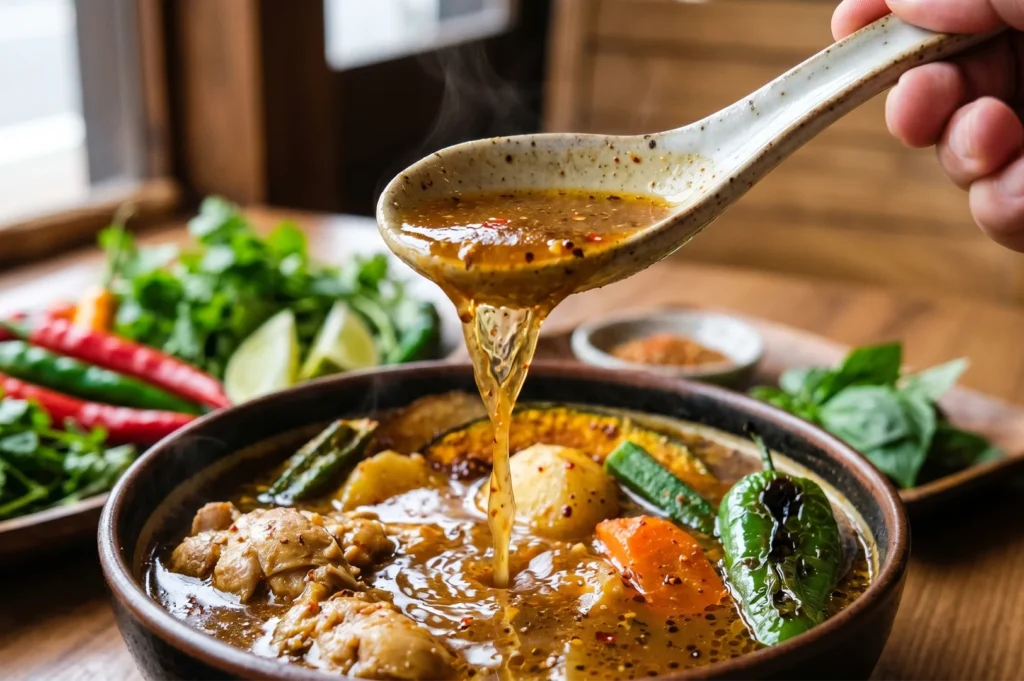
We focus on soup rather than thicker curries because it highlights the colour of ingredients, vegetable texture, and spice clarity. Thick sauces often hide produce quality, while soup demands perfection in every element.
Our kitchen fills with toasted spices and fresh herbs aromas daily. We carefully control flame intensity to balance the broth, neither too sweet nor too sharp. This labour of love is shared with every guest.
The Evolution of the Palate
Returning guests often tell us that their second or third visit feels different from their first. They notice things they had not noticed before. This is not by accident. Our soup is designed to reveal itself gradually, and so is the experience of the person tasting it.
Spice, Season, and Subtlety
As our guests continue to explore our offerings, they often remark on how the bitter or sweet notes change depending on the season. This is the beauty of using fresh, locally sourced or specially imported produce. Unlike mass-produced mixed curry powders that offer a uniform taste, we craft our base with a depth that evolves.
We help our guests navigate their choices, suggesting the level of spice that suits their individual tolerance. We have found that when people are not overwhelmed by the heat, they are more likely to notice the subtle herbaceous notes that elevate the dish. It is a thing of beauty to watch someone discover the nuance in a spoonful of our broth, realising that it is not just a hot liquid, but a complex, layered creation.
Food as Connection
For those who have been won over by the experience, it is usually because they appreciate the integrity of the prepared dish. They understand that food is more than just fuel; it is a way to bring people together. The people who frequent our restaurant value the work that goes into every bowl, from the slow-cooked meat to the precise timing required for each vegetable.
A Final Note on Authenticity and Comfort
In dynamic Singapore, trends come and go, but authentic Hokkaido-style soup curry remains timeless. We focus on preserving its true essence to offer a consistently excellent dining experience.
Whether for a quick lunch or a relaxed dinner, we aim to provide comfort and a genuine sense of place. Proudly part of Singapore’s vibrant culinary scene, Soup Curry by Ki-Setsu promises a memorable visit.
Next time you seek something beyond ordinary, join us to discover why the best curry is a fragrant, spiced soup and not a thick stew. It’s a simple, satisfying pleasure we’re excited to share, one bowl at a time.